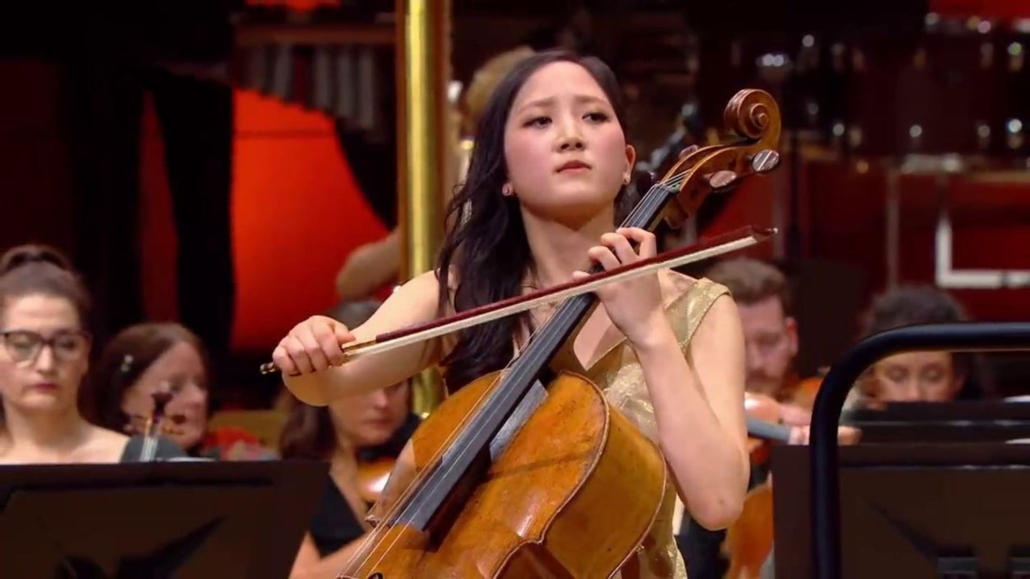
The instrument that Hayoung Choi will bring to her Victoria Symphony debut is arguably more famous than its proprietor, but that’s not necessarily going to be the case for long.
Thanks to the generosity of an anonymous benefactor, the young South Korean cellist has the use of a rare instrument made in 1707 by Giuseppe Giovanni Battista “filius Andrea” Guarneri, one of the most accomplished craftsmen then working in Cremona, Italy. As musical instrument enthusiasts all recognize, Cremona was the epicentre of European luthiery, the place where new and innovative forms of the violin and guitar were developed and, arguably, perfected. And in all the city’s workshops, three families stood above all rest: Amati, Stradivari, and Guarneri.
The son of the first Guarneri master, Andrea, and father of the even more accomplished Bartolomeo, Giuseppe Guarneri was born in 1666 and entered his apprenticeship almost as soon as he could walk. By the turn of the 18th century, he was at the peak of his powers, and would make several significant innovations in instrument design, most notably by reshaping the violin to produce sweeter and more penetrating tones. Guarneri cellos are less common than violins; some 30 to 35 are estimated to exist, although who knows how many more might be languishing in dusty palazzos and castles?
Beyond that, only a handful of these gorgeous and significant cellos are allowed out to play—which is understandable, given that on the rare occasion that they come up for sale, examples in fine original condition can bring upwards of 10 million U.S. dollars. Air travel with a such a precious device is not to be taken lightly.
There’s another reason to be excited about Choi’s instrument: her Guarneri formerly belonged to Janos Starker, one of the greatest 20th-century cellists and an artist on par with the better-known Pablo Casals, Yo-Yo Ma, and Mstislav Rostropovich. Starker was known for the purity and precision of his sound, and for devotees of his art, being in the presence of his instrument is the equivalent of making a pilgrimage to Mecca or Lourdes.
All this is interesting—and, yes, perhaps just slightly hyperbolic—but can Choi play at a comparable level?
The answer, resoundingly, is “Yes.”
To date, the 28-year-old’s greatest achievement came in 2022, when she captured the Queen Elisabeth Competition’s first prize for cello with her performance of Franz Joseph Haydn’s Cello Concerto No. 1 in C major—the same work that she’ll essay with the Victoria Symphony and its music director, Christian Kluxen. Choi’s winning recital is viewable online and leaves no doubt that she has a great affinity for the work: she is forceful in the growling chordal sweeps of the first movement, lyrical in the “Adagio”, and commanding in the “Allegro molto” finale.
Although likely considered a virtuoso showcase when it was composed in the early 1760s, the Cello Concerto No. 1 is not, by today’s standards, a technically demanding pinnacle of the cello literature. (Although it has its moments.) It does, however, offer an effective bridge between the Baroque era of Johann Sebastian Bach and the Classical innovations that Haydn and Wolfgang Amadeus Mozart furthered; its discovery in a Czech archive circa 1961 certainly expanded our understanding of music in its composer’s lifetime. And its relative simplicity leaves no room for the soloist to hide: it demands forthright commitment and complete emotional engagement for it to take flight. These, Choi delivers to a degree that fully justifies her stewardship of Starker’s magnificent Guarneri.
Also on today’s program are the overture from Gioachino Rossini’s Il signor Bruschino, another Haydn masterwork in the form of his Symphony No.75 in D major, and Sergei Prokofiev’s Symphony No. 1 in D major. The Rossini overture has some musical significance, containing references to Mozart and his Italian contemporary Domenico Cimarosa, but it is undeniably a bagatelle, a good-humoured introduction to a program that will mostly continue in the key of warmth—even if there is a ghoulish footnote stemming from Haydn’s first visit to London, in 1792, during which the “Andante” from the Symphony No. 75 was performed.
“There was an English clergyman who sank into the deepest melancholy on hearing my ‘Andante’, because the night before he had dreamt that such an Andante was a premonition of his death,” the composer reported upon his return to Vienna. “He immediately left the company and took to his bed.” A month later, he added, “this Protestant clergyman had died.”
Prokofiev’s Symphony No. 1, in contrast, marks a birth—the birth of a major voice in Russian music. Written between 1916 and 1917, at the time of the February Revolution in Petrograd, it is assured and elegant but contains little of the angst that would come to characterize the composer’s music during the Soviet era. Consider it the calm before the storm, and as its “Classical” nickname indicates, a fitting companion to the works of Haydn and Rossini.
Notes by Alex Varty


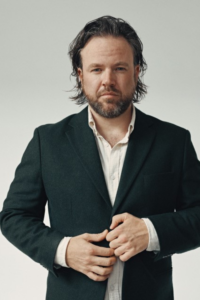 Christian Kluxen, conductor
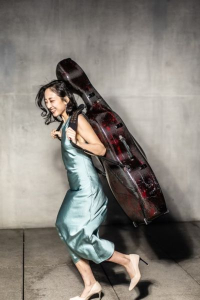 Hayoung Choi, cello