“Heaven,” the pop songwriter and performance artist David Byrne once wrote, “is a place where nothing ever happens.” But that was in 1979, long before Samy Moussa finished writing Elysium for an international consortium of presenters, including the Wiener Philharmoniker and the Vancouver Symphony Orchestra. A great deal happens in the Montreal-born composer’s 12-minute opus—although, to be fair, much of it happens at a glacial pace.
The title, Moussa told this writer in a 2021 interview, stems from his research into pre-Socratic philosophy, and more particularly the Sicilian philosopher Empedocles’s idea that eternal life in the “Elysian Fields” would be granted to those who live a virtuous existence. Not that he wants us to read too much into how he names his compositions.
“This is the danger of titling works,” he says. “If I would have given this piece another title, we would be having a different discussion. It’s really dangerous. That’s why I’m not so comfortable… I mean, I don’t write program notes altogether because of that, because there’s nothing to explain. But also, a title is already too much, yet I don’t want to title my piece 1, 2, 3, 4, 5.”
“If you read Homer, for example, then yes, one could say that Elysium is paradise for the fallen gods, or for heroes,” he continues. “But I don’t think this is really the point. The point is more the concept of reward, and a life well-lived. What does ‘a life well-lived’ mean? That’s the question. It’s an ethical question; it’s not so much a superficial, poetic description of successful gods or heroes. That’s really the point of the piece—and of my work in general. It’s about human life and what we do with it”
Struggle is not removed from virtue in this piece. The slow pacing of the introduction suggests labour, resistance, and the accretion of self-knowledge through analysis rather than revelation. And the way Elysium then opens up into glorious technicolour harmony assures listeners that satisfaction without compromise can be had in this world—and that music is our best path to heaven, whether there is an afterlife or not.
If this takes time, so be it.
“I can pinpoint maybe two elements in my work that are consistent,” Moussa notes. “One of them is time, but not time in terms of form, of length of the work, but time in terms of how much is time is given to the listener to comprehend what is happening. Practically, that means that very often in my music the harmonic flow is slow. Another element would be clarity. I think this is very important in my music.… I’m not satisfied when it’s not clear. It has to be very, very clear. This is very important to me.”
“I never really ask myself why I do it, why I write music,” he adds. “I don’t really have an answer to that. It’s just something that I discovered I could do when I was young, and I kept on with it. It became a habit. And I think it can be very rewarding to work on something for a very long period of time without, in a way, being able to access it completely because it’s not played or performed yet. You work on something, you craft something for a long time, and it’s quite abstract. And then the reward of the performance—a good performance, especially—is really incredible.”
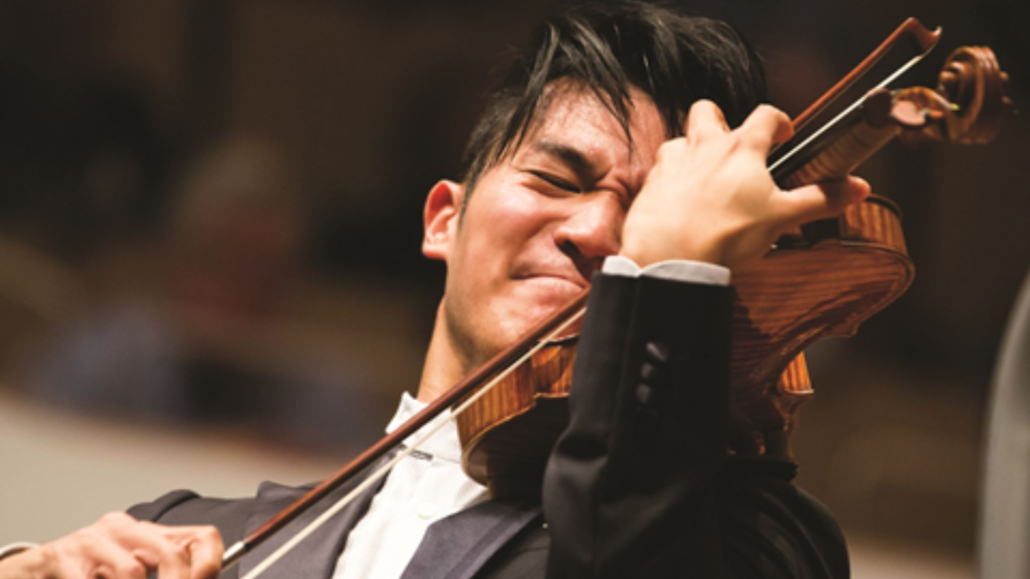
Showing early signs of talent is something that Moussa, who has just entered his 40s, shares with the other composers on this program. Felix Mendelssohn made his concert debut as a pianist at nine; published his first score, a piano quartet, at 13; and finished his first symphony two years later. His Violin Concerto in E minor, which here will feature Taiwanese-American soloist Ray Chen, is arguably a late work, but the composer was still in his thirties when it was premiered in 1845. Mendelssohn died, from a series of strokes, just two years later.
The Violin Concerto certainly suggests that Mendelssohn’s short but productive life was well lived. As Joseph Joachim, one of the preeminent violinists of the 19th century, told guests at his 75th birthday party, “The Germans have four violin concertos. The greatest, most uncompromising is Beethoven’s. The one by Brahms vies with it in seriousness. The richest, the most seductive, was written by Max Bruch. But the most inward, the heart’s jewel, is Mendelssohn’s.”
Béla Bartók was also a child prodigy and then a composer of jewels, many of them expressing his native Hungary’s Magyar heart through their highly inventive transfiguration of Transylvanian and other Eastern European folk melodies. (While Mendelssohn documented his travels in surprisingly accomplished watercolours, Bartók was an early adopter of portable recording equipment and one of the most significant ethnomusicologists of the 20th century.)
By the time he wrote the Concerto for Orchestra in 1943, he was a long way away from his early successes, both physically and metaphorically. Self-exiled to New York City shortly after the start of the Second World War and suffering from the leukemia that would kill him in 1945, he was writing little music until his friend, Boston Symphony Orchestra conductor Serge Koussevitzky, generously threw him a lifeline. This offer of meaningful work prolonged Bartók’s life, renewed his creativity, and resulted in a concerto that, although not without the composer’s characteristic spikes and thorns, is almost universally loved today—a posthumous reward for a life that was very much well-lived.
Notes by Alex Varty


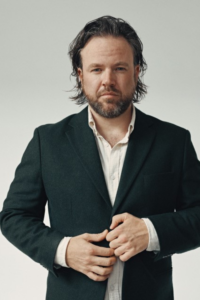 Christian Kluxen, conductor
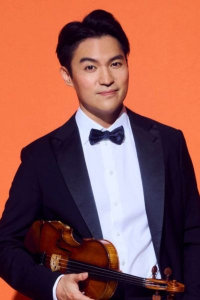 Ray Chen, violin