Should you happen to find yourself on Dallas Road looking south, it’s easy to imagine yourself on top of the Olympic Mountains, looking back across the Strait of Juan de Fuca. There’s another way of breathing clean mountain air and scaling dizzying heights (one that doesn’t risk avalanche) and that’s what’s on offer when the Victoria Symphony and guest conductor Norman Huynh premiere Samuel Kerr’s new concerto for percussion and orchestra.
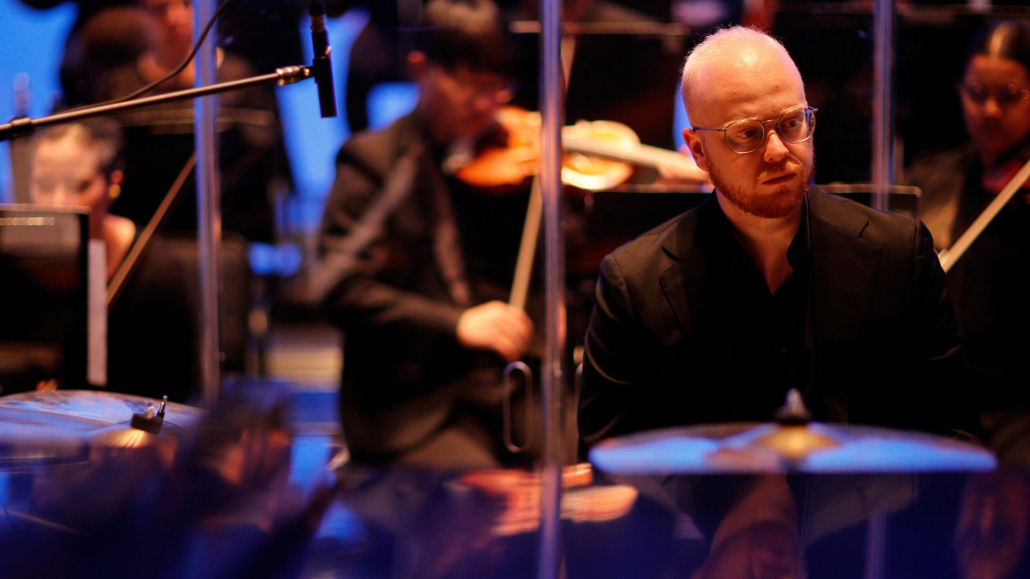
Mountaintides finds the Calgary-born composer far away from his present location in Philadelphia—where he’s a Rita E. Hauser Conducting Fellow at the Curtis Institute of Music—but fully immersed in his other life as a keen explorer of the Rocky Mountain slopes. (Check out Kerr’s hiking diaries at www.samuelkerrmusic.com/blog for more information on his trekking exploits.) It also pays tribute to the joys of friendship, and more particularly the composer’s almost decade-long collaboration with VS principal percussionist Jacob Valcheff.
“Jacob is a good friend of mine from our undergraduate studies at University of Toronto, and he just sort of randomly, during Covid, said ‘Hey, I’m thinking about putting a new vibraphone piece on a recital for this year. Do you want to write one?’” Kerr explains. “This was probably the most fun part of Covid for everyone: the fall of 2020 when it was just desolate and awful. I said yes, and it was kind of my first or second experience of somebody taking a risk and asking me to write a piece. At the time Jacob was living in downtown Toronto, and we’d noticed that, walking down King Street we couldn’t hear anything except for the birds singing. So, I wrote this piece called Stillness for him, which was about listening, and silence where we don’t expect it, and I sort of wrapped in my Albertan sensibilities with the mountain landscapes. I enjoyed the piece, and I think he did too, but it sort of sat there for a while, and in the interim we both graduated and he won this wonderful job with the Victoria Symphony.
“It’s my understanding that principal players are often asked ‘Would you like to play a concerto this coming season?’” Kerr continues. “And he pitched the orchestra a number of the classics, but when they were talking about potential repertoire, he said, ‘Oh, I have this friend of mine who has already written a percussion concerto,’ which I had two years before, for the University of Toronto Wind Ensemble. He sent them to my website and they listened, and apparently, they liked what they heard!”
As well they should have. Kerr is himself an extremely accomplished percussionist, and his writing combines technical challenges for the soloist alongside a harmonious, even rhapsodic, experience for the listener. The composer considers his alpine pieces to be “offerings” to the audience and hopes that through sound they’ll feel some of the same exaltation that he’s experienced in nature.
“I have so many special, profound memories of just feeling small in the mountains,” Kerr says. “Moments in which I’ve figured out something about myself or life or music while being on the top of a ridge or whatever. And I would love it if the music I write, including this concerto, can offer some glimmer of that to an audience member.
“It’s not like it has to be ‘Oh, wow, we’re in Lake Louise,’” he adds, laughing. “But for me it is about where I was raised, and where my parents threw me in our free time. ‘Let’s go to the Rockies! Let’s go to Shawnigan Lake!’ And having spent all my post-secondary years in Toronto and Boston and Philadelphia, which are not necessarily beacons of the natural world, it’s just something that’s on my mind. Maybe it’s an escape; maybe It’s a longing for some removal from the city. But if I close my eyes and just think of a soundscape, I go there first.”
Kerr knows that Mountaintides is in good hands with Valcheff. “He’s a very organized, diligent player,” he notes, “and I appreciate that our relationship includes a lot of implicit understanding of one another, musically. I understand him as a player; I understand his strengths and what he likes to play. And I think he understands my music quite well, having played a few of my pieces.”
The composer is also pleased that Mountaintides will be paired with Aaron Copland’s The Tender Land Suite and Ludwig van Beethoven’s Symphony No. 1 in C major. The Brooklyn-born-and-bred Copland’s music often conveys a yearning for the wide-open spaces that he never knew during his years in New York City and Paris. Beethoven, too, was a passionate rambler and a keen student of the natural environment. For Kerr, both epitomizes the kind of clarity he’s seeking in his own music.
“Something I’ve appreciated more as I’ve gotten older is the beauty of simplicity in music,” he says. “If you’re working with a Ferrari like the Victoria Symphony, you can do as much as you want: you can go super far, if you want to. But I think something that was taught to me by playing a lot of Steve Reich—and even Iannis Xenakis, in a way—is understanding that if you strip things down, every little change is so much more meaningful than it would be otherwise. And I think there’s a lot of beauty in the comparative simplicity of something like Copland or even Beethoven, early Beethoven, where the music is just kind of what it is. It’s right in front of you, and you can just hold it in your hands. Which isn’t to say that I don’t love beautiful, complex, sprawling, challenging, thick contemporary music, but composers like both Copland and Beethoven have taught me a lot about just keeping music simple, and I’m hoping to channel some of that in this new concerto.”
Notes by Alex Varty


 Norman Huynh, conductor
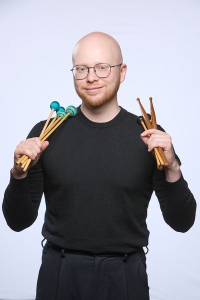 Jacob Valcheff, percussion