Blame it on the wabbit.
For those of us of a certain age—and by that we mean those of us who have met or exceeded our Biblical allotment of three score years and 10—our initial exposure to symphonic music quite probably came by way of animated cartoons. A mixed blessing, some might contend!
Certainly a positive influence would have been Walt Disney’s Fantasia, first shown in 1940 but on frequent repeat ever since. This undeniable masterpiece, with its “greatest hits” score, so inextricably linked Music and Magic that its third “M”, Mouse, is very much the junior partner. But that other anthropomorphic animal, Bugs Bunny, likely led his impressionable viewers to take a more skeptical view of at least one composer: Richard Wagner. The enduring vision of that trickster lagomorph decked out in winged helmet, bustier, and thick blonde braids remains hilarious—and surprisingly sophisticated for 1957. (Drag shows for children are clearly not only a modern phenomenon.)
But What’s Opera, Doc?, which is loosely based on the second instalment of Wagner’s Ring cycle, Die Walküre, also suggests that operatic storylines tend towards the cartoonish, with the controversial German being perhaps the worst offender in that regard.
Wagner’s contemporaries certainly did not hold back on expressing their scorn for his Deutschland über alles nationalism, Aryan fantasies, and sexual libertinism. Writing in her diary after viewing Tristan und Isolde, the ever-astute Clara Schumann called it “the most repulsive thing I ever saw or heard in my life”.
“To have to sit through a whole evening watching, listening to such love-lunacy till every feeling of decency was outaged….was—I may well say—the saddest experience of my whole artistic career,” Schumann continued. “It is not emotion that the opera portrays, it is a disease, and they tear their hearts out of their bodies while the music expresses it all in the most nauseous manner.”
Others of less refined sensibility disagreed, flocking to Wagner’s self-created Bayreuth Festival with all the enthusiasm of K-Pop fans or Beatlemaniacs. And Schumann might have been off the mark in her assessment of Wagner’s music, if not his plots. For the late Richard Taruskin, writing in his comprehensive and invaluable Music in the Nineteenth Century, the composer was not quite the radical his more fervent admirers proposed, but offered a kind of apotheosis—to use a very Wagnerian word—of the European harmonic sensibility.
“Despite the reputation of Tristan und Isolde as having instigated a ‘crisis of tonality’ with its notorious freedom of chromatic modulation, Wagner (unlike Liszt and Mussorgsky) exercised his freedom entirely within the established practice of functional harmony,” Taruskin contends. “Far from threatening it, he managed to wring from the common practice an unprecedented realization of its interdependent structural and expressive potentials.” In the case of Tristan und Isolde, he added, “That overwhelming intensification of attraction and desire, as we have seen, is the whole poetic point. The assumption that Tristan somehow started the process whereby functional harmony was fatally and inexorably weakened is an excellent example of historicist mythmaking.”
Tristan und Isolde is not excerpted in tonight’s program, which is devoted to the late conductor Lorin Maazel’s 75-minute condensation of Wagner’s four-opera cycle, Der Ring des Nibelungen. But Schumann and Taruskin’s arguments are equally applicable to Der Ring, and in fact highlight the ongoing controversies around Wagner, which range from the state of Israel’s blanket prohibition of his music to the enthusiastic embrace of his antisemitism by today’s neo-Nazis.
There is no denying that Wagner was repulsive in his personal beliefs and in his extreme sense of entitlement. “I am not made like other people,’’ he once said. “I must have brilliance and beauty and light. The world owes me what I need.’’ In addition to his bigotry, he was an adulterer, a welsher on debts, a health crank, and was known to be contemptuous of other composers, such as Clara Schumann’s friend and protégé Johannes Brahms, whom he should have more properly considered peers.
So is it possible to set Wagner’s personality aside to take a dispassionate look at his music? The often forbidding gap between art and artist is one that may never be properly bridged, but Maazel has managed it as well as possible. When the Telarc record label initially proposed the idea of a condensed Ring in 1987, Maazel was skeptical, reportedly considering it a potential “desecration” of great art. We don’t know why he came around, but surely one factor was his desire to make Wagner’s music more accessible to modern audiences by presenting every last highlight from Das Rheingold, Die Walküre, Siegfried, and Götterdämmerung. It’s worth noting that Maazel was the first American conductor to perform at the Bayreuth Festival. And significant, too, that he was of Jewish ancestry, having been born in France to American Jewish parents in 1930. His Ukrainian grandparents, like so many others from that region, fled the threat of Russian pogroms in 1900, eventually settling in New York City.
There are so many shades of grey in this story that, ultimately, it’s up to the individual to determine their position on Wagner’s life and art. Maazel’s stance is itself ambivalent. “I just shake my head when it comes to this sort of thing, because there are issues involved, and I understand,” he told Jewish Currents in 2013, shortly before his death. “I think if I had parents who were cooked in an oven in one of these concentration camps, I wouldn’t feel very enthusiastic. Because it’s irrational, okay, it’s emotional, which I appreciate. It’s visceral. It’s very well and good for us, who’ve never been involved in any of the horrors that took place during the Second World War, to be ‘objective’. It’s quite hard for those who were involved or escaped from these camps, or had people in their family who lived through these horrible experiences.”
Nonetheless, some will want to have nothing to do with Wagner’s music, while others might stand with Bugs: gazing on its substance with wry affection but maintaining a cool and ironical distance from its creator and his intent.
Notes by Alex Varty


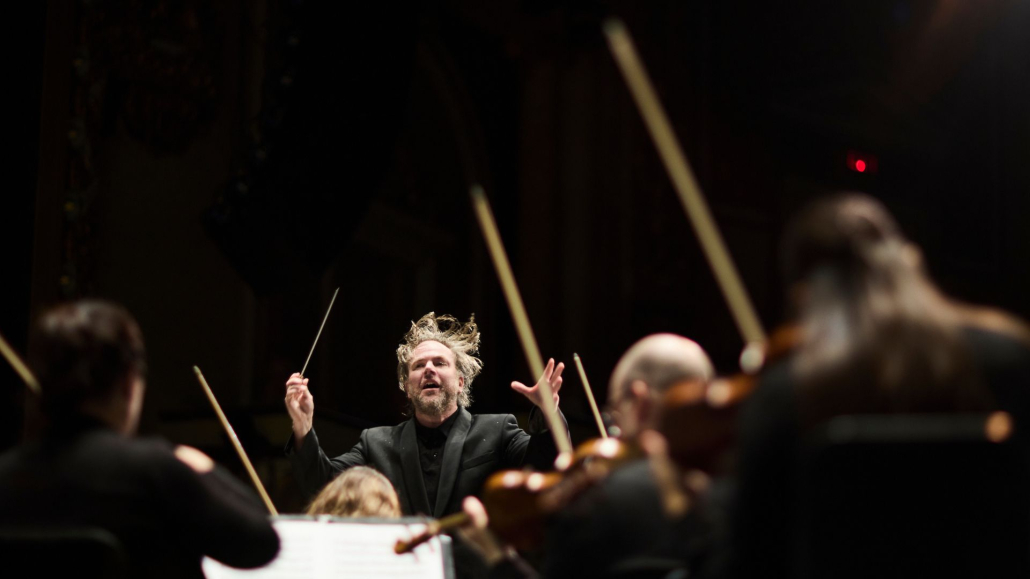
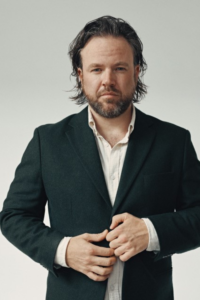 Christian Kluxen, conductor