It’s safe to say that you are going to be knocked out—and possibly even amazed—by Arin Sarkissian’s performance of Einojuhani Rautavaara’s flute concerto, Dances with the Winds.
“Why so sure?” you might want to ask. Well, because we’ve already heard it.
Oh, there’s no need to worry. We haven’t yet heard the flute virtuoso attempt Rautavaara’s masterpiece with the Victoria Symphony; we’re writing program notes, not designing time machines. But we have heard, and seen, Sarkissian playing the piece with the National Youth Orchestra of Canada—it’s available on YouTube—and immediately recognized it as a singular accomplishment. As modest as he is, Sarkissian acknowledges that, too.
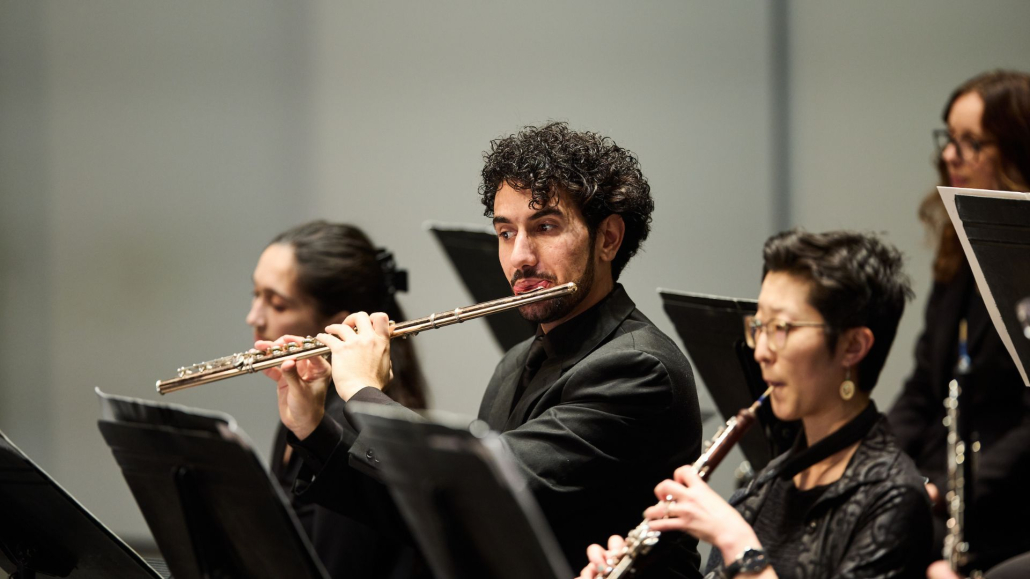
“I knew this would be a very unique challenge, on top of the exceptionally difficult musical demands,” the Victoria Symphony’s principal flautist explains, adding that those demands include playing alto flute, bass flute, and piccolo alongside his regular concert instrument. “I don’t own a bass flute or alto flute, and playing piccolo has not always been my specialty,” he notes. “I don’t know what got into me to take on this piece amidst the logistical uncertainty and intimidation, but sometimes you just have to take the leap. I genuinely remember thinking: ‘This could go very wrong.’ It was reckless courage, but I have no regrets.”
“Playing all four instruments in this piece becomes a unique showcase,” he continues. “It essentially spans the full range of the flute family, and each flute comes with its own set of quirks. The standard flute is of course most familiar to me—my ‘home base’, perhaps—so it becomes a bit of a mental game to recalibrate expectations from instrument to instrument. Challenges include intonation tendencies, fingerings, air volume, air direction, aperture shape, and even something as basic as holding each instrument with stability and balance. It all becomes a kind of juggling act, but it’s been fascinating to face challenges beyond the usual concern of just playing the right notes. It becomes mental, logistical, physical, and musical all at once.”
Dances with the Winds argues in favour of a larger reappraisal of Rautavaara’s place in contemporary music, and Victoria Symphony music director Christian Kluxen says that the same might also apply to Rautavaara’s Danish predecessor, Ruen Langgaard. The second movement of his Symphony No. 14, which he subtitled “Morgenen/The Morning”, provides this concert’s opener.
“Langgaard was visionary, but also too fragile to have faith in his own visions—and that is not a great combination,” the conductor explains. “He often had ideas before everyone else—strange harmonic fields, almost cluster-like sonorities, obsessive repetitions, sudden mystical stillness, violent or surreal gestures—and then, when the world did not understand, he doubted himself and moved somewhere else. And then there are all these titles: Stars, Morning, Heaven, Revelation, The Spheres. With Langgaard, that is not just decoration. It is part of his imagination. He is constantly looking upwards and out while he cannot escape his own traumas. He also chose some very difficult fights. In Denmark he was standing in the shadow of Carl Nielsen, who was the central figure in Danish music. At the same time, Langgaard wanted to continue the great German symphonic tradition after Brahms, Bruckner, Wagner, and Mahler. That is not exactly an easy position to put yourself in. Too German for Denmark, too Danish for Germany, too late-Romantic for the modernists, too strange for the conservatives. I think he is highly underrated.”
It’s not entirely fanciful to hope that we’ll hear more from Langgaard in future Victoria Symphony seasons; Kluxen says that limiting his local introduction to an excerpt from a longer work does not do his countryman full justice. Nor is it merely coincidence that the adventurous Dane be placed on the same program as a work by the arch-conservative of Viennese music, Josef Strauss. While both wrote works titled Music of the Spheres, Kluxen contends that Strauss’s Sphärenklänge “turns the idea of the spheres into a waltz. It becomes social, elegant, Viennese. Langgaard’s music is in a completely different world: remote, mystical, much stranger. The point is that both composers are drawn to something celestial, but Strauss brings it down to the ballroom, while Langgaard keeps it far away.
“I also think we should not underestimate the works of Josef Strauss and the creations of that family,” the conductor continues. “Their works are so familiar, we can easily treat them as light entertainment. But there is real refinement here. Brahms admired the Strauss world very much, and that should make us listen more carefully. Behind the charm there is enormous craft and an instinct for movement and form. It is very easy to make this music sound cheap. It is much harder to make it elegant and alive.”
In that quest, setting becomes consummately important. And that, for Kluxen, is why the central work on this program—its underpinning, if you will—comes from the pen of an earlier Viennese master, Franz Schubert.
“Schubert’s Symphony No. 5 in B-flat major is not cosmic like Langgaard and not glittering like Strauss,” he stresses. “It has something more natural. It breathes, sings, and dances, but never becomes superficial. Everything sounds simple, but it is not. That is part of Schubert’s genius: the refinement is everywhere, but it does not show off. And this is also how Schubert connects to Strauss. The Viennese world of song, dance, melancholy, and grace is hard to imagine without Schubert. He is behind so much of it. With Schubert, dance is rarely just dance. There is always something difficultly human underneath. That is why he fits so well in this program—and for me the arc of the concert is not a strict historical argument. It moves between different kinds of light: Langgaard’s morning light, Rautavaara’s northern light, Schubert’s clear human daylight, and Strauss’s celestial ballroom light.”
Four distinct levels and degrees of light? This is a program that will be illuminating.
Notes by Alex Varty


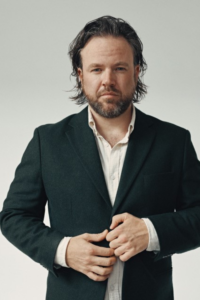 Christian Kluxen, conductor
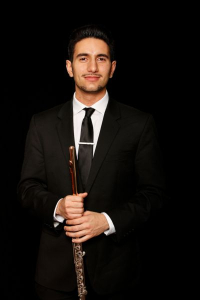 Arin Sarkissian, flute / piccolo / alto flute / bass flute