Eugene Tzigane wants you to experience Franz Schubert’s Symphony No. 9 in C major in a whole new way—by going back to how it used to be done.
It’s not that Tzigane is old-fashioned. A quick flip through his résumé shows that he has premiered a long list of contemporary works. But when it comes to the core of the classical repertoire, he believes strongly that modernist interpretations miss the mark. To truly take the measure of this material, he says, it’s best to consult the conductors who came before the post–Second World War crop of podium superstars—musicians like Herbert von Karajan, George Szell, and especially Wilhelm Furtwängler, who had a direct link to the Romantic era through his mentor Felix Mottl.
Early recordings of classical repertoire, Tzigane argues, are “wildly different from what’s been done in the last 40 years. People don’t do that anymore, except for me. but that’s because I am a liberal when it comes to how to interpret a score, for anything that comes before modernism. Once you get to modernism, composers pretty much want you to play it as it’s written—and it usually works better that way, when it’s a really good composer. But almost all the music that was written before World War I has the understanding that there is no perfect version. [The score is] just a map of a city, as I like to call it. How you get from A to B is up to you, but the map itself isn’t the city. You have to traverse the city yourself and explore it yourself.
“I take the written score as a starting point, and try to open up the possibilities,” he continues. “What does the music tell me? What’s behind the notes? What does the analysis say? What are the possibilities for turning these abstract sounds into a story? Because for me [Richard] Wagner really revolutionized the art of interpretation for conductors. He opened up the idea that conductors could be storytellers in abstract music: that you are introducing characters and drama, and that everything is connected—but not that the tempo should be the same throughout. This modern idea of unity through monotony or homogeneity is the antithesis of what I like in earlier repertoire, like Schubert.”
The essence of Tzigane’s approach is to let the music breathe. “A lot of the performances of the last 50 years, they start at one tempo, and they stay in one tempo. And I just don’t think that players from when Schubert was alive could even hold the tempo in that way,” he explains. “Once conductors started to become more ‘masters of their art’ in the mid 1800s, then this idea that you could manipulate tempo on a large scale and show the different chapters in a symphony and tell is as a dramatic storyline came about.”
Wanting to explore this further, we turned to Disc 48 in the massive, 107-CD Wilhelm Furtwängler: Das Vermächtnis box set to hear how the German maestro approached Schubert’s Symphony No. 9 story. It’s somewhat revelatory. Modern ears might miss the clarity and precision of some later interpretations, the bringing out of filigreed nuances in the strings and woodwinds, but there’s no denying that Furtwängler’s approach is dramatic. Under his baton, and with the empathetic support of the Berliner Philharmonic, the Symphony No. 9 presents as a Manichean struggle between darkness and light, which fits well with what we know of Schubert’s experience of both all-consuming joy and the ever-present threat of illness and death.
Interpreting the Symphony No. 9 as a personal odyssey is particularly apt in a program that also encompasses Jacques Hétu’s Légendes and Richard Strauss’s Concertino for Clarinet and Bassoon in F major. Légendes, commissioned in 2007 to mark the 400th anniversary of Quebec City, dramatizes supernatural journeys in two of its three movements: “Alexis le trotteur” was inspired by the folk legend of Alexis Lapointe, a long-distance runner apparently capable of outpacing a thoroughbred horse, while “La chasse-galerie” dramatizes the demonic pact entered into by a passel of lumberjacks so that they could attend a New Year’s Eve dance via a flying canoe. And while Strauss considered his Concertino the musical encapsulation of a Beauty and the Beast romance between a princess and a bear—represented here by the clarinet and bassoon, respectively—he’d also compared it to the original Odyssey, in which Homer’s hero traversed the unmapped Mediterranean before returning home to tell the tale.
As for the narrative dimension in Schubert 9, Tzigane notes that it’s “an odyssey of its own”.
“It’s just such a massive work,” he observes. “When we say ‘the great C major’, great is not a qualitative but a quantitative assessment. It’s the grand C major, as opposed to the little C major, which is number six. But for me, as a work, it has all the emotional, human elements that a Mahler symphony has. It has simplicity and it has melancholy; it also has moments of real, downright terror in the second movement, where he is staring into the abyss and having an existential experience where it seems like the whole world is coming apart at the seams. And then how he recovers from that is one of the most beautiful and cathartic moments in all of symphonic music—but it’s not usually handled very well because if you. play it just as its written it doesn’t really tell that story very well. So that’s where I think a lot of earlier conductors, remnants of the old German Romantic school, told the symphony as a story in a much more convincing way. For me, it hits me in my chest. It goes straight to my heart, and it transcends the intellectual.
“That’s also, for me, the goal: that any person who comes to the concert should be able to process, on an emotional level, what’s happening,” Tzigane adds. “They don’t need to come to a pre-concert talk: they’ll just get it. And I’ve had that experience a lot. I don’t have to explain my interpretation because it’s all there in the character—and for me that’s a beautiful thing.”
Notes by Alex Varty


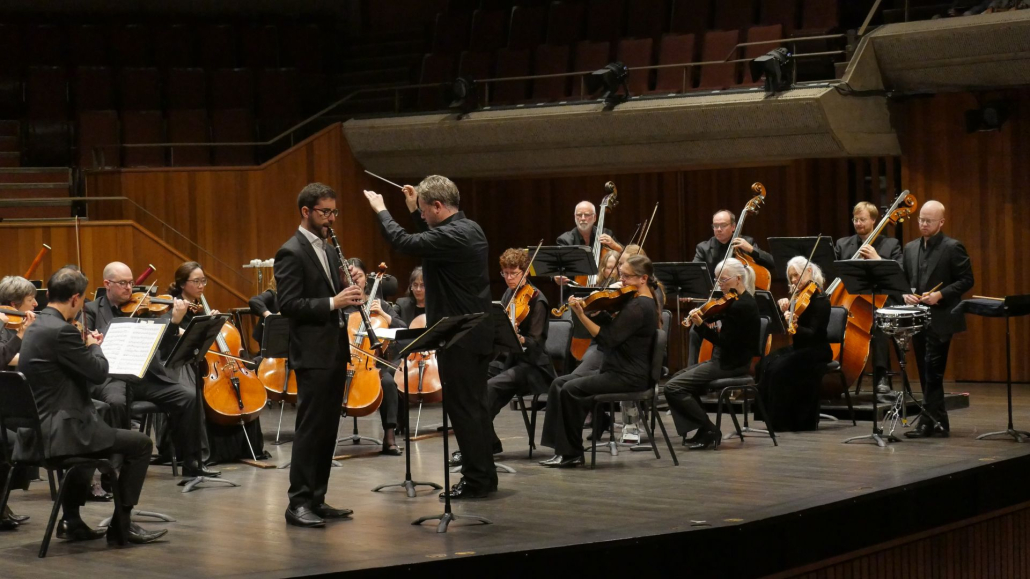
 Eugene Tzigane, conductor
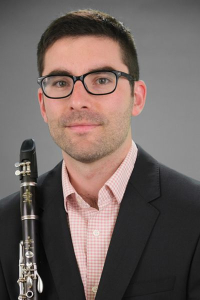 David Boutin-Bourque, clarinet
 Jennifer Gunter, bassoon