Loading Events

« All Events

Season Special: Kluxen – Ray Chen Plays Mendelssohn

November 8 @ 2:30 pm

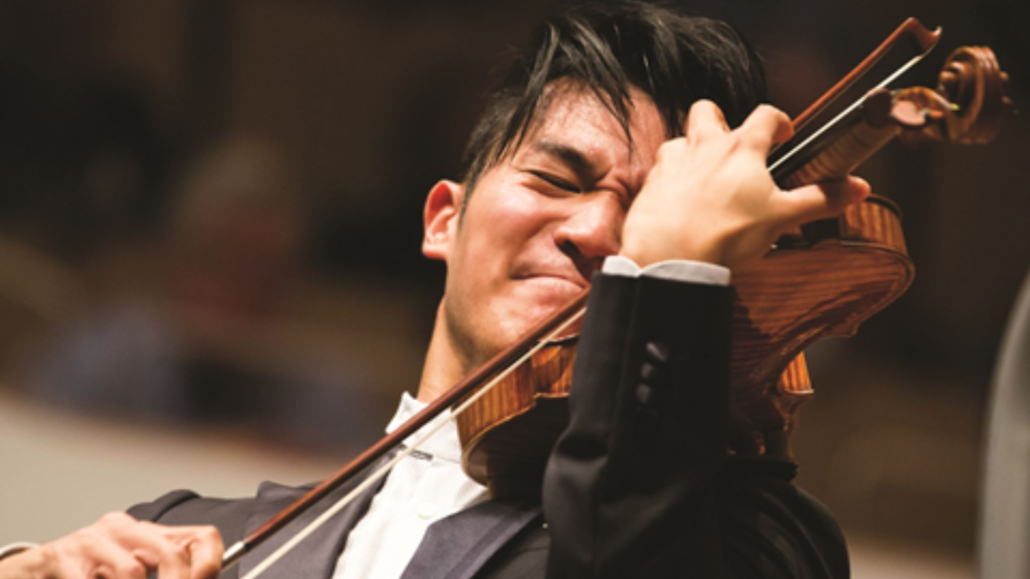
Superstar violinist Ray Chen—one of the most celebrated classical artists on the world stage—makes his long-awaited Victoria debut. Acclaimed for his awe-inspiring technique, deep artistry, and magnetic presence both on stage and online, Chen performs Mendelssohn’s beloved Violin Concerto, a perfect showcase for his radiant virtuosity. The concert opens with Canadian composer Samy Moussa’s Elysium, a luminous vision of reward and renewal. Bartók’s masterful Concerto for Orchestra, written in exile yet brimming with vitality and hope, concludes the afternoon and continues the VS’s exploration of the composer’s bold, transformative orchestral works.

Not included in subscription purchase discount but can be booked at the same time as a subscription package. Single tickets on sale starting July 21, 2026.

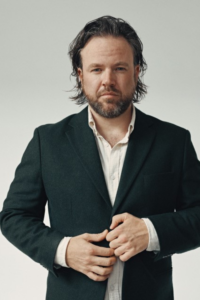
Christian Kluxen, conductor

Christian Kluxen is now in his tenth season as Music Director of the Victoria Symphony in Canada, following a five-year tenure as Chief Conductor of the Arctic Philharmonic in Norway.

 Kluxen has been described in the press as “a dynamic, charismatic figure” who “forms the music with an impressive vertical power of emotion and a focus on the grand form”, conducting “with exemplary clarity and a heavenly warmth”. He is recognized for his sincere and transparent leadership, innovative programming, and his bold, imaginative, and energetic interpretations, showcased both in his MD and guest work.

 Alongside his many and varied commitments with the Victoria Symphony, recent and forthcoming guest engagements include Turku Philharmonic (where he was Principal Guest Conductor for three seasons) Orchestre de Chambre de Lausanne, Pacific Symphony, Oregon Symphony, Vancouver Symphony, Orchestre symphonique de Québec, Prague Radio Symphony Orchestra, Copenhagen Philharmonic, Odense Symphony, Aalborg Symphony and Norrköping Symphony. A fruitful and inspiring relationship with the Arctic Philharmonic, whom Kluxen led for five years as Chief Conductor, resulted in numerous exhilarating performances of a wide variety of repertoire, as well as several acclaimed recordings. 

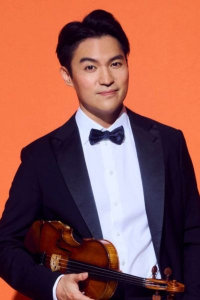
Ray Chen, violin

Violinist and online personality, Ray Chen redefines what it means to be a classical musician in the 21st century. With a global reach that enhances and inspires a new classical audience, Ray Chen’s remarkable musicianship transmits to millions around the world, reflected through his engagements both online and with the foremost orchestras and concert halls around the world. Beyond the performing arts, his work has also contributed to philanthropy, popular culture, and educational technology.  

Initially coming to attention via the Yehudi Menuhin (2008) and Queen Elizabeth (2009) Competitions, of which he was First Prize winner, he has built a profile in Europe, Asia, and the United States as well as his native Australia both live and on disc. Signed in 2017 to Decca Classics, the summer of 2017 has seen the recording of the first album of this partnership with the London Philharmonic as a succession to his previous three critically acclaimed albums on SONY, the first of which (“Virtuoso”) received an ECHO Klassik Award. Profiled as “one to watch” by the Strad and Gramophone magazines, his profile has grown to encompass his featuring in the Forbes list of 30 most influential Asians under 30, appearing in major online TV series “Mozart in the Jungle”, a multi-year partnership with Giorgio Armani (who designed the cover of his Mozart album with Christoph Eschenbach) and performing at major media events such as France’s Bastille Day (live to 800,000 people), the Nobel Prize Concert in Stockholm (telecast across Europe), and the BBC Proms.  

He has appeared with the London Philharmonic Orchestra, National Symphony Orchestra, Leipzig Gewandhausorchester, Munich Philharmonic, Filarmonica della Scala, Orchestra Nazionale della Santa Cecilia, Los Angeles Philharmonic, SWR Symphony, New York Philharmonic, San Francisco Symphony, Pittsburgh Symphony, Berlin Radio Symphony, and Bavarian Radio Chamber Orchestra. He works with conductors such as Riccardo Chailly, Vladimir Jurowski, Sakari Oramo, Manfred Honeck, Daniele Gatti, Kirill Petrenko, Krystof Urbanski, and Juraj Valcuha.  

More recently, Ray Chen co-founded Tonic, an independent startup that aims to motivate musicians and learners around the world to practice their craft together. Although new, the innovative app has cultivated a highly engaged and supportive community and is available to download on iOS and Android today. Ray Chen’s presence on social media makes him a pioneer in an artist’s interaction with their audience, utilizing the new opportunities of modern technology. His appearances and interactions with music and musicians are instantly disseminated to a new public in a contemporary and relatable way. He is an ambassador for SONY Electronics, a music consultant for Riot Games – the leading esports company best known for League of Legends, and has been featured in Vogue magazine. He released his own design of a violin case for the industry manufacturer GEWA and proudly plays Thomastik Infeld strings. His commitment to music education is paramount, and inspires the younger generation of music students with his series of self-produced videos combining comedy, education and music. Through his online promotions his appearances regularly sell out and draw an entirely new demographic to the concert hall.  

Born in Taiwan and raised in Australia, Ray was accepted to the Curtis Institute of Music at age 15, where he studied with Aaron Rosand and was supported by Young Concert Artists. His previous instrument was the 1714 “Dolphin” Stradivarius, once owned by Jascha Heifetz, on generous loan from the Nippon Music Foundation. In 2025, Ray began a new chapter in his musical journey, exploring the world of rare violins and play-testing 24 Stradivari and Guarneri del Gesùs (and counting). Among them, a 1727 Stradivarius has become one of his favorites so far and is the instrument he currently performs on. 

Scan to sign up for Ray’s newsletter!

Samy Moussa (1984—)
Elysium

Felix Mendelssohn (1809—1847)
Violin Concerto in E minor
I. Allegro molto appassionato
II. Andante
III. Allegretto non troppo – Allegro molto vivace

INTERMISSION

Béla Bartók (1881—1945)
Concerto for Orchestra
I. Introduzione: Andante non troppo – Allegro vivace
II. Giuoco delle coppie: Allegretto scherzando
III. Elegia: Andante non troppo
IV. Intermezzo interrotto: Allegretto
V. Finale: Pesante – Presto

“Heaven,” the pop songwriter and performance artist David Byrne once wrote, “is a place where nothing ever happens.” But that was in 1979, long before Samy Moussa finished writing Elysium for an international consortium of presenters, including the Wiener Philharmoniker and the Vancouver Symphony Orchestra. A great deal happens in the Montreal-born composer’s 12-minute opus—although, to be fair, much of it happens at a glacial pace.

The title, Moussa told this writer in a 2021 interview, stems from his research into pre-Socratic philosophy, and more particularly the Sicilian philosopher Empedocles’s idea that eternal life in the “Elysian Fields” would be granted to those who live a virtuous existence. Not that he wants us to read too much into how he names his compositions.

“This is the danger of titling works,” he says. “If I would have given this piece another title, we would be having a different discussion. It’s really dangerous. That’s why I’m not so comfortable… I mean, I don’t write program notes altogether because of that, because there’s nothing to explain. But also, a title is already too much, yet I don’t want to title my piece 1, 2, 3, 4, 5.”

“If you read Homer, for example, then yes, one could say that Elysium is paradise for the fallen gods, or for heroes,” he continues. “But I don’t think this is really the point. The point is more the concept of reward, and a life well-lived. What does ‘a life well-lived’ mean? That’s the question. It’s an ethical question; it’s not so much a superficial, poetic description of successful gods or heroes. That’s really the point of the piece—and of my work in general. It’s about human life and what we do with it”

Struggle is not removed from virtue in this piece. The slow pacing of the introduction suggests labour, resistance, and the accretion of self-knowledge through analysis rather than revelation. And the way Elysium then opens up into glorious technicolour harmony assures listeners that satisfaction without compromise can be had in this world—and that music is our best path to heaven, whether there is an afterlife or not.

If this takes time, so be it.

“I can pinpoint maybe two elements in my work that are consistent,” Moussa notes. “One of them is time, but not time in terms of form, of length of the work, but time in terms of how much is time is given to the listener to comprehend what is happening. Practically, that means that very often in my music the harmonic flow is slow. Another element would be clarity. I think this is very important in my music.… I’m not satisfied when it’s not clear. It has to be very, very clear. This is very important to me.”

“I never really ask myself why I do it, why I write music,” he adds. “I don’t really have an answer to that. It’s just something that I discovered I could do when I was young, and I kept on with it. It became a habit. And I think it can be very rewarding to work on something for a very long period of time without, in a way, being able to access it completely because it’s not played or performed yet. You work on something, you craft something for a long time, and it’s quite abstract. And then the reward of the performance—a good performance, especially—is really incredible.”

Showing early signs of talent is something that Moussa, who has just entered his 40s, shares with the other composers on this program. Felix Mendelssohn made his concert debut as a pianist at nine; published his first score, a piano quartet, at 13; and finished his first symphony two years later. His Violin Concerto in E minor, which here will feature Taiwanese-American soloist Ray Chen, is arguably a late work, but the composer was still in his thirties when it was premiered in 1845. Mendelssohn died, from a series of strokes, just two years later.

The Violin Concerto certainly suggests that Mendelssohn’s short but productive life was well lived. As Joseph Joachim, one of the preeminent violinists of the 19th century, told guests at his 75th birthday party, “The Germans have four violin concertos. The greatest, most uncompromising is Beethoven’s. The one by Brahms vies with it in seriousness. The richest, the most seductive, was written by Max Bruch. But the most inward, the heart’s jewel, is Mendelssohn’s.”

Béla Bartók was also a child prodigy and then a composer of jewels, many of them expressing his native Hungary’s Magyar heart through their highly inventive transfiguration of Transylvanian and other Eastern European folk melodies. (While Mendelssohn documented his travels in surprisingly accomplished watercolours, Bartók was an early adopter of portable recording equipment and one of the most significant ethnomusicologists of the 20th century.)

By the time he wrote the Concerto for Orchestra in 1943, he was a long way away from his early successes, both physically and metaphorically. Self-exiled to New York City shortly after the start of the Second World War and suffering from the leukemia that would kill him in 1945, he was writing little music until his friend, Boston Symphony Orchestra conductor Serge Koussevitzky, generously threw him a lifeline. This offer of meaningful work prolonged Bartók’s life, renewed his creativity, and resulted in a concerto that, although not without the composer’s characteristic spikes and thorns, is almost universally loved today—a posthumous reward for a life that was very much well-lived.

Notes by Alex Varty

Details

  • Date: November 8
  • Time:
    starts at 2:30 pm
  • Event Category:

Venue

  • Royal Theatre
  • 805 Broughton St + Google Map
  • Phone 250.386.6121

Concert Programme

  • Samy Moussa
    Elysium
  • Mendelssohn
    Violin Concerto in E minor
  • Bartók
    Concerto for Orchestra

Supporters

Victoria Symphony respectfully acknowledges and offers gratitude to the lək̓ʷəŋən people, known today as the Songhees and Xwsepsum Nations, whose unceded lands we live, work, and perform on. We honour their stewardship, care, and leadership — past, present, and future.