Canadian composer Vivian Fung’s next big commission is a daunting one: reimagining the American national anthem for Santa Cruz, California’s Cabrillo Festival, to mark the 250th anniversary of our southern neighbour’s birth. Given all that’s gone on in the past decade, this is unlikely to be a rah-rah, John Philip Sousa makeover—but that’s not really Fung’s style, anyway. She’s more likely to come up with music that’s thoughtful, eloquent, and pointedly multicultural—something more like her work on this program, Parade.
That’s not to say that Parade is short on flash and dazzle; there’s too much exuberant percussion in this piece for that. But it grew out of a period of enforced quiet and contemplation—the Covid pandemic and lockdown of the early 2020s—and captures that mood perfectly before depicting a joyous Lunar New Year celebration of in San Francisco’s historic Chinatown.
This balance of inner reflection and outward engagement is more relevant than ever, Fung says. “I live down here in California and everything is so fraught and divided,” the composer explains, speaking from her home in the Bay Area. “I think the meaning behind Parade is so needed and necessary. We’re just all craving that human interaction.”
And music, she adds, is one of the best ways of bringing people together. “It’s a very powerful force, because music is something that is non-verbal,” Fung says. “We focus so much on the concrete and the verbal and the visual that, for me at least, music enters a different realm. When the creative juices are flowing, it becomes something spiritual—and when you have a powerful performance and that combination of people in the audience and the performers, it can recreate that.”
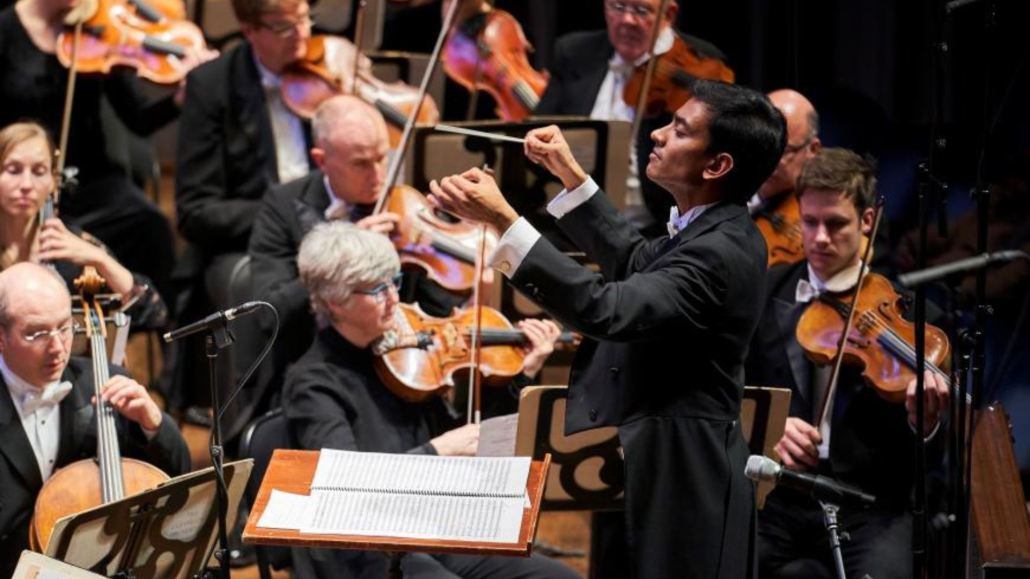
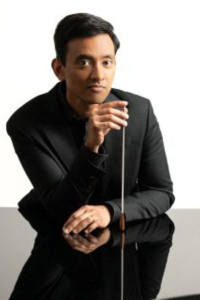
Conductor Vinay Parameswaran is eager to test that theory. “I know the Victoria Symphony really prides itself on championing Canadian artists, Canadian composers, and so there were many that came to mind when thinking about this program,” the California-born, Vancouver-based musician says. “But Vivian is really one of the greatest living Canadian composers, and just her whole catalogue is really fascinating. So she was the first person I thought of for this opener.”
Fung’s ability to weave together different moods and disparate voices is a large part of her appeal, he adds, citing Parade’s resemblance to the more festive works of the like-minded Charles Ives. “Difference is what makes our world beautiful. We have all these elements, and that’s a really powerful thing about her work.”
The program Parameswaran has assembled for this concert reflects that belief. There are few overt connections between Fung’s Parade, Franz Liszt’s Piano Concerto No. 1 in E-flat major, and Pyotr Ilyich Tchaikovsky’s Symphony No. 1 in G minor, but the conductor does see some parallels, at least between the concert’s opener and its finale.
“With Vivian’s piece, it’s looking back to the pandemic, to this traumatic time that we all went through, and the sense of loneliness that we all felt during that time,” he says. “For us musicians, we were lucky to even be on-stage, playing to an empty hall, you know. Being spread apart, with no connection with audiences at all… I think her piece is starting with that but also talking about how we can celebrate what a diverse community we have.
“For Tchaikovsky,” he continues, “it’s a lot also about looking back to his roots, and to his people. It’s a piece that’s littered with Russian folk songs throughout all four movements. So there’s a nostalgic element to both pieces that ties the outer parts of our program together.”
One could argue, too, that both works chart a passage out of introversion and into an outwardly focused self-actualization. The Symphony No. 1 in G minor, in particular, refutes the popular characterization of its composer as a master of doom and gloom; by the time Tchaikovsky reaches the end of his winter journey, whether actual or metaphorical, he’s able to convey a real sense of optimism or even exultation.
“If you read the accounts of what the process was like for him writing that piece, it’s anything but that,” Parameswaran points out. “It was panic attacks, it was stress, it was self-doubt… It was all those things. The pressure of writing a first symphony for any serious composer.
“In classical music, we have this pantheon of great first symphonies, right?” he adds. “Things that are bold and make a statement: Beethoven 1, Mahler first, Shostakovich first, Sibelius first. And of course [Hector Berlioz’s] Symphonie fantastique is the greatest example of that. I just love how out there and wild that piece is. And I think it’s the same for Tchaikovsky. Tchaikovsky 1 might not have the same substance or maturity or gravitas as the later symphonies, but it’s unmistakably his voice, and you hear so much of what’s to come in this symphony. You hear the gorgeous melodies, the melodies that are full of longing. You hear the charm of the ballet music that’s to come. You hear the bombast of Tchaikovsky 4 in the finale, with the percussion and low brass. You hear all those elements that we love about Tchaikovsky in this symphony.”
And the Liszt? Well, for Parameswaran it’s primarily a spectacular forum for the remarkably gifted teenage piano prodigy Sophia Liu. But the conductor also has a personal connection to the work that some might find surprising. “Liszt gets a bad rap because we think so much of it is, like, fluff and fireworks,” he says. “But he really cared about form. He really cared about structure, and you hear it in this concerto: the first four measures reappear everywhere. They come back in the third movement, and the whole finale is based on that. He really cared about that arc, and it really showcases what an amazing pianist he was.
“But my favourite part, as an old percussionist, is that the triangle gets its soloistic moment in the scherzo. That always makes me happy.”
Notes by Alex Varty


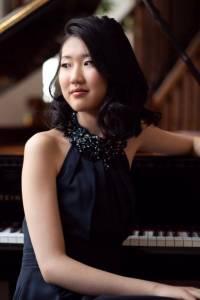 Sophia Liu, piano