Is there a School of Shostakovich? And if not, why not?
Well, there is a Shostakovich School of Music, Art and Dance, in Brooklyn, New York. Founded by Russian émigrés in 1981, it offers private and group lessons to aspiring artists, beginning with a daycare program that caters to children as young as one year and 10 months. But there’s nothing in the school’s online syllabus to indicate that the late composer’s music or methods are part of the curriculum.
Nor does Dmitri Shostakovich seem to have spawned many composer-disciples, although his works are revered by performers world-wide. During his lifetime, which spanned from 1906 to 1975, his work provoked strong opinions both positive and negative. The English composer William Walton once called him the most significant composer of the 20th century, while Walton’s rival and successor Benjamin Britten considered him an inspiration and a good friend. But Shostakovich’s near-contemporary and countryman Igor Stravinsky believed that the younger musician had betrayed his early promise by choosing to work within entirely traditional forms, and within the stylistic strictures of the Politburo.
Closer to home, when the CBC Radio Orchestra commissioned the Shostakovich Project in 2006, 10 Canadian composers, ranging from avant-jazz bandleader John Korsrud to former Victoria Symphony composer-in-residence Douglas Schmidt, were happy to sign on. Most, like Schmidt and the late Jocelyn Morlock, even used motifs from Shostakovich in their tributes, but none claimed him as a primary influence.
Perhaps that’s because Shostakovich was so purely a product of his time and place: a Russian modernist obliged to placate culturally conservative champions of Soviet realism, but also having to reflect a world of bureaucratic paranoia, mass starvation, gulags, and the horrors of the Second World War. He may well be inimitable.
On the other hand, new forms of those horrors and constraints are metastasizing in today’s world, and Shostakovich’s signature blend of explicit emotional intensity and encoded protest are due for a rebirth. As Victoria Symphony music director Christian Kluxen says, “His music feels increasingly necessary. Some composers become more historical with time. Shostakovich somehow becomes more relevant, which is fortunate for Shostakovich but unfortunate for history.”
Ending the Victoria Symphony’s 2026/27 Season with Shostakovich’s Symphony No. 7 in C major, then, meets several different objectives. As Kluxen notes, it is “a massive physical experience” that requires incredible diligence on the part of its performers. It is dark but ultimately uplifting; a fitting analogy for the value of art in a time of pressures both economic and political. And as much as anything by Ludwig van Beethoven or Johann Sebastian Bach, it celebrates the resilience of the human spirit in the face of the aforementioned stresses.
“The story around the “Leningrad” Symphony is almost impossible to separate from the piece,” Kluxen points out. “It has one of the most dramatic origins of any symphony. There is also a conscious connection to another work we performed earlier in the season: Béla Bartók’s Concerto for Orchestra. During the war, Shostakovich’s Seventh was performed repeatedly in America, while Bartók, who was in exile in the United States and in a very difficult situation, struggled to get his own music heard. In Concerto for Orchestra, he seems to make a rather grotesque caricature of the famous ‘invasion’ theme from Shostakovich’s Seventh. But that joke has another layer, because Shostakovich’s theme itself seems to echo Franz Lehár’s The Merry Widow, often described as Hitler’s favourite operetta. So Bartók may have thought he was mocking Shostakovich, but he was also touching on a musical joke that was already pointed somewhere else.
“I like that kind of irony,” the conductor continues, “because it shows how complicated the world around this symphony is. Even the jokes have shadows behind them. And with Shostakovich there is always another layer. The Seventh is obviously connected to invasion, war, and fascism. But the violence in the piece is also the violence of machinery, repetition, stupidity, fear, and systems that turn human beings into material. That is why the piece still feels alive. It is not only a document from 1942. Oppression can come from many places. We live in a time where many of the things his music says are again very close to us: war in Europe, propaganda, fear, the fragility of truth, the feeling that history can suddenly become brutal again.”
Hannah Arendt’s famous observation about “the banality of evil” seems apropos. “The famous invasion episode is frightening because of its insistence,” Kluxen says. “It starts almost stupidly, innocently, and then grows into something monstrous. That is one of Shostakovich’s sharpest insights: evil mostly arrives as banality repeated loudly enough and long enough.
“For a season finale, this may sound heavy,” he adds. “But a finale does not always have to mean easy celebration. It can also mean culmination. This piece leaves an audience shaken but not only shaken. The ending is enormous, and it should almost blow the room open. It is triumphant, but not naïve. It is a triumph that has cost something. For me, the ‘Leningrad’ Symphony is ultimately about human resistance: memory, irony, culture, and the refusal to become numb—and that is why it belongs at the end of the season.”
Should current events require a revival of Shostakovich-style methods in the symphonic world, this will be a mixed blessing. It will signify that we have entered into another era of reactionary thinking, struggle, and death, one in which many millions will suffer needlessly. And yet artistic engagement with the cruel facts of life will provide us with hope for a better world—and, as per Shostakovich’s example, moments of scarifying yet invigorating beauty.
Notes by Alex Varty


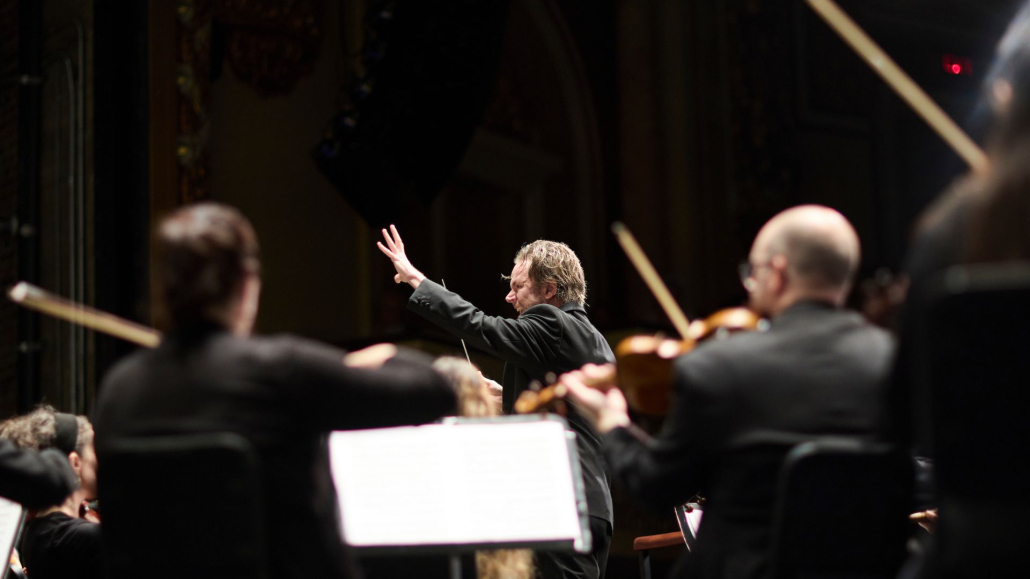
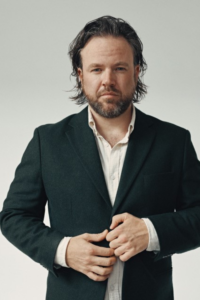 Christian Kluxen, conductor