It is entirely probable that only a few of us—perhaps only those of Lithuanian descent, dedicated Deutsche Grammophon collectors, or obsessive readers of serious music magazines—will have heard Raminta Šerkšnytė’s music before tonight. A few more, however, will have experienced what seems to have inspired the opening bars of Šerkšnytė’s Midsummer Song, which here will serve to introduce Jean Sibelius’s Symphony No.3 in C major and Wolfgang Amadeus Mozart’s Piano Concerto No. 9 in E-flat major.
Sailors, farmers, shift workers, and those who simply want to make the most of our short summers will all recognize the dawn chorus that precedes the actual rising of the sun, and the insectile thrum that will grow as the day warms. Interpretations of what follows will necessarily be less precise: a thunderstorm? A fitful siesta? Vague intimations of something unsettling in the heat? After giving us clues to her setting, Šerkšnytė moves into more abstract terrain, but without ever abandoning what Victoria Symphony music director Christian Kluxen calls her “very personal sound world”.
“There is something poetic in her music, but it is not soft or decorative,” the conductor explains, illustrating why he has become a staunch proponent of the 51-year-old Lithuanian composer’s art. “It has atmosphere and direction. It feels as if the music comes from a very specific inner landscape. Midsummer Song has this combination of light and intensity that I like very much. There is warmth in it, and a sense of nature, but also something ritualistic. It does not try to impress through surface complexity. It creates an atmosphere and then lets that atmosphere grow. That is often more difficult than writing something full of obvious effects.”
“‘Landscape painting,” he continues, “makes the music sound too passive, as if it were just describing scenery. With Sibelius and Šerkšnytė, landscape becomes part of the form. It affects the breathing of the music and the sense of time. In Nordic and Baltic music, nature is often more than background. Light, darkness, distance, forest, water, summer nights, winter silence—these things enter the musical imagination. Perhaps that is quite close to the role of wilderness in Canadian art. In music, though, the interesting thing is not just the landscape itself, but what it does to time and our presence in it.”
Midsummer Song is only 14 minutes long, but it both compresses and expands time in the way that it encapsulates an entire day, or perhaps even an entire season. Once the listener is fully engaged in Šerkšnytė’s universe, small gestures take on immense significance, invoking one’s own memories of summer heat, ripening crops, and warm and languorous evenings. Perhaps this ability to build an immersive world from minute and precise observation is one link to Kluxen’s programming here, which is logical and provocative but not necessarily easily understood.
“With Sibelius, the music often feels as if everything grows from one small cell,” the conductor says of the Symphony No. 3. “With Šerkšnytė, there is more of a glowing, ritual quality, but the sense of nature as something inner is crucial.”
The Finnish musicologist and Sibelius expert Ilkka Oramo suggests that Sibelius’s 1906 composition might also contain something ritualistic, perhaps stemming from Sibelius’s abandoned oratorio, Marjatta, which combined Finnish myth and Christian symbology.
“It has been pointed out,” Oramo contends, “that the passages featuring a hymn or chorale topos are exceptionally numerous in the Third Symphony and that such passages can be found in all three movements.
“Hidden programmatic reasons may also lie behind the fact that the Third Symphony has only three movements,” he continues. “It is not out of the question, although by no means proven, that the movements spiritually correspond to the birth, funeral, and resurrection of Christ in the Marjatta libretto. In this case, the hymn-like concluding section of the ‘Finale’ could be interpreted as the expectation and hope of Christ’s resurrection and its actual happening.”
“The Sibelius/Mozart connection is perhaps the most interesting part of the program for me,” Kluxen adds—and there’s no need for him to mention that Mozart was also adept at encoding hidden spiritual messages beneath the glossy surface of his compositions.
The early Classical composer and the late Romantic “might seem far apart,” he continues, “but Symphony No. 3 is the least monumental of Sibelius’ symphonies. It is smaller, lighter, more classical, and more condensed than the others—perhaps apart from the Seventh (which is monumentally condensed). It feels as if Sibelius has reduced it, cooked it down like a stock, until only the essential material is left. That gives it a Mozart feeling, in discipline. Nothing is unnecessary. The surface can seem clear, even modest, but underneath there is enormous control. Mozart is almost cruelly good at making something highly refined feel completely natural. Sibelius does something like that in the Third Symphony. Mozart’s Piano Concerto No. 9 has youth, elegance, and brilliance, but also a surprising amount of depth, as if Mozart is already speaking with complete personal freedom.”
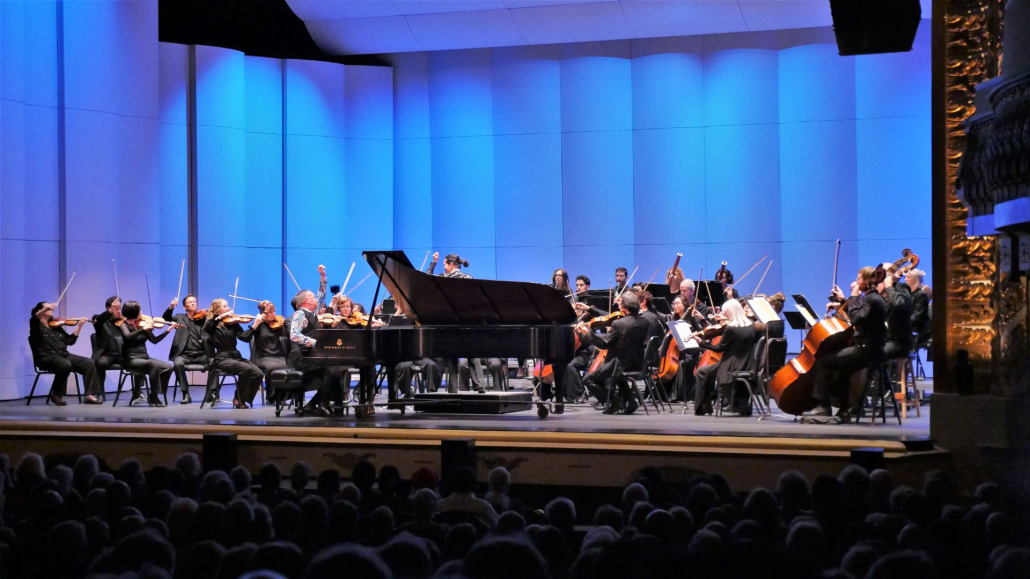
Taken together, he adds, these three works have “a lot to do with lightness in the difficult sense, where there is no fat, where everything is only essence.” And what can be more essential than light? It’s immaterial and yet alters everything we see and feel. Šerkšnytė’s summer glow, Sibelius’s greyer Finnish skies, and Mozart’s candlelit indoor elegance—amplified by soloist Jon Kimura Parker’s assured touch—all come together in one surprising and satisfying whole.
Notes by Alex Varty


 Christian Kluxen, conductor
 Jon Kimura Parker, piano