“There is a world beyond the world, but it’s in this world.” So wrote Paul Éluard, and if any concert embodies the French Surrealist poet’s bon mot, it’s this one—especially as it will open with the late Canadian composer Jocelyn Morlock’s Oiseaux bleus et sauvages.
Morlock’s untimely death in 2023 robbed us of a singular and singularly eloquent talent, but every time one of her works is performed, those who knew her well can be assured that her gifts live on. This is especially true of Oiseaux, an emblematic example of her ability to mix otherworldly beauty with impressions that are very much rooted in the composer’s deep affinity for the natural world.
“That makes a lot of sense,” Morlock told me in 2016. “It was the first orchestral piece I ever wrote, and it’s a pretty joyful, optimistic piece. It might be the happiest thing I ever wrote.
“It was all downhill from there,” she added, but we shouldn’t read too much into that. Morlock’s sense of humour could be as dry and dark as her compositions are full of light.
Morlock acknowledged that she was an admirer and student of the French composer Olivier Messiaen’s avian-inspired masterpieces, but in Oiseaux bleus et sauvages she’s drawn both on her own birdwatching adventures and on the “crazy, bird-like sounds” that open Igor Stravinsky’s The Rite of Spring. So it’s fitting that her Oiseaux is here paired with works by Stravinsky’s Russian countryman Nikolai Rimsky-Korsakov and his Spanish contemporary and friend Manuel de Falla.
Listen closely, and you might even hear birds in de Falla’s garden and Rimsky-Korsakov’s oriental palace.
Conductor Maurice Cohn definitely sees links between all three compositions. Oiseaux, the American musician says, “has a kind of love of life that I think is quite present in the rest of the program as well. And it is so colourful, and so much fun to get to know. There’s a little surprise around every corner. You go from these few flutes at the beginning to the whole orchestra shortly thereafter… I don’t know. I would hesitate to say that it’s about something specific, other than the title, but I think that the energy of it, the optimism of it, is what originally attracted me to it.”
Beyond that, he continues, “Some pieces of music are journeys, where you start at one place and the goal is to get to the end. And some pieces of music are cathedrals, where the goal is to open every door and explore every room, but you remain in the same place the whole time. And for me, this concert is more that than the first. It’s not a good or bad thing; there are just different things in the world. And if there’s a word that ties these works together, maybe it’s ‘fantasy’. They’re very provocative for the imagination.
“None of this is inauthentic,” he adds. “I don’t mean to say that. But it’s still imagined. The goal is not musical accuracy of some other place. The goal is that the fantasy of this ‘other’ allows you to create a new version of your own self.”
Here, Cohn seems to be echoing Jeanette Winterson’s wonderful book One Alladin, Two Lamps—like Rimsky-Korsakov’s Scheherazade, a retelling of the Arabian Nights—in which the English novelist explores the art of story-telling as a form of self-creation. It’s a useful analogy.
“A lot of this kind of writing is about self-description, even through the description of something else,” the conductor comments. “For instance, Rimsky-Korsakov, in reaching for the story of Scheherazade and in reaching for a musical world very far from his own, it’s not as if he was an authority on these other musical and literary traditions. He doesn’t really know what he’s talking about. but what he’s doing is that he’s reacting: he’s reacting to the Tchaikovsky generation, and he’s reacting to a feeling among Russian composers that they’ve been too Germanized, that they don’t have their own voice. They don’t have their own way of making music that isn’t the same as Vienna and all these other places. And so he’s reaching for something that feels new and feels different and feels sort of fantastical. I don’t think that his version of this story has all that much to tell us about Middle Eastern or Arabic musical traditions!”
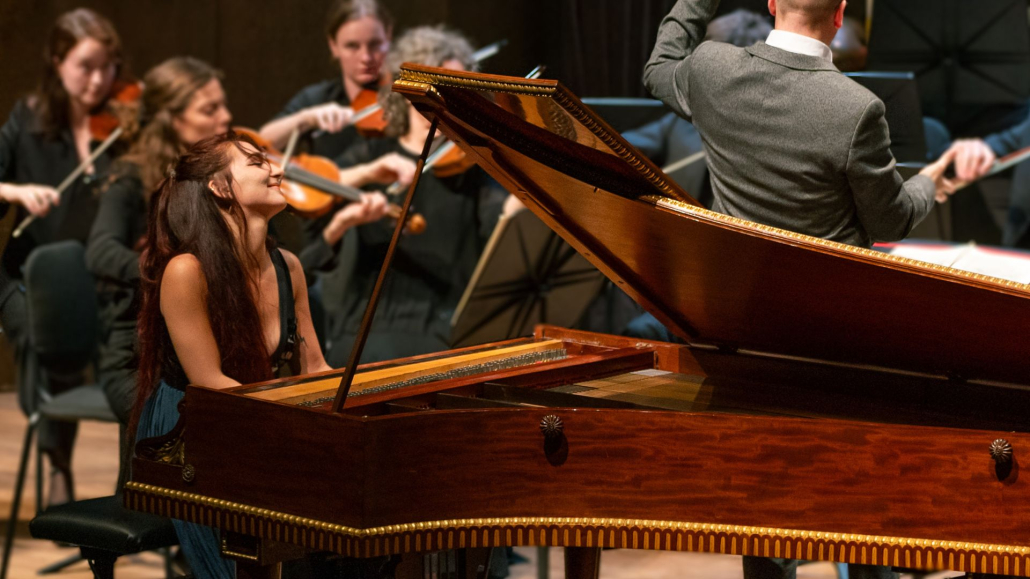
De Falla’s Noches en los jardines de España is more explicitly influenced by Arabic art, both the fractal patterns of Islamic architecture and the echoes of Arabic melody in Spanish flamenco. At the time of our interview, soloist Élisabeth Pion is still familiarizing herself with the score; it’s a new addition to her repertoire, she admits. By the time she takes the Victoria Symphony stage, however, she’ll have some stories and impressions of her own to add to her interpretation of this Iberian masterpiece.
“In the coming year and a half, I’m performing and recording all of the Beethoven concertos, and so I was recently in Bonn at Beethoven’s house, just to analyze the scores and see the first editions,” the Quebec-born, London-based pianist explains. “I love the process of getting to know a piece and getting to know the composer, so definitely I will go to Spain. I will go to the gardens, I will smell the jasmine, and I will make myself ready to enter de Falla’s world.
“And also, I need to read some Garcia Lorca!” she adds, laughing. “It’s missing in my cultural knowledge, so that’s also another world I need to dive into.”
Is it fair to expect poetry, story-telling, and landscape painting from this single musical event? Yes, it very much is.
Notes by Alex Varty


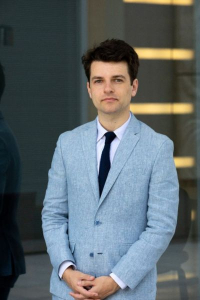 Maurice Cohn, conductor
 Élisabeth Pion, piano