Reviewers were not altogether kind to William Walton’s only cello concerto when it was premiered in 1957. They didn’t knock the performance, and how could they, when two genuine legends—conductor Charles Munch and soloist Gregor Piatigorsky, the work’s dedicatee—were on the stage? But the concerto itself came under intense and often unkind scrutiny. Although critics praised its “warm and melodious” contours and “singularly lovely epilogue”, they also stressed that whatever modernist touches the work contained “would not alarm an elderly aunt”, and suggested that Walton, once the enfant terrible of British music was stagnating in his middle age.
Seventy years later, the Cello Concerto seems ripe for reappraisal, especially in the context of a Victoria Symphony season marked by many works that convey a distinct sense of place. At the time of its composition, Walton was living on the Italian island of Ischia, and it’s easy to attribute the work’s warmth and luminosity to the Mediterranean climate, perhaps mixed with degree of nostalgic fondness for Walton’s pre-war life in London. (Listen closely, and you can hear the strains of 1920s salon music lilting through the lemon groves.)
The score is undeniably well constructed, perhaps because its writing involved much back-and-forth discussion with Piatigorsky. If it has been overlooked, it’s perhaps because Walton had the misfortune of being a kind of bridge between two of England’s most iconic composers, Edward Elgar and Benjamin Britten, as both conductor Bertie Baigent and cello soloist Cameron Crozman suggest.
“As cellists, we play the Elgar Cello Concerto all the time,” Crozman points out. “I’ve also recorded the Britten cello suites, and I’ve always really loved Britten’s music. So it’s been interesting to get to know Walton’s music. which is its own thing. It’s still within that tradition, but he’s a unique voice. I’ve been reading that he was very inspired by the music of Stravinsky and Debussy, and I find that there is this very colourful, almost French style to this concerto. There’s something impressionistic about the colours of the orchestra—and I studied in Paris for six years, so I find a certain kinship there.”
At the time of the Cello Concerto’s writing, Baigent suggests, Walton was “sort of a grand old man of British music, and Britten had been snapping at his heels. Britten was the young, hot composer and Walton was not quite in vogue any more; he was quite old-fashioned. But in terms of its colour and its form, its crystalline moments, the Cello Concerto is quite an intricate piece to put together. And it’s only just surpassed by the Elgar cello concerto, isn’t it?”
On paper, tonight’s program looks wildly eclectic, but there are various paths that can lead us through this assemblage of the Cello Concerto, Vancouver composer Marcus Goddard’s audiovisual overture Antarctica: Life Emerging, Maurice Ravel’s Pavane pour une infante défunte, and Wolfgang Amadeus Mozart’s Symphony No. 41 in C major. There are certainly echoes of Ravel in much of Walton’s writing. while the fact that it concludes in the key of C major, Baigent says, is a bridge to Mozart. The program can also be seen as a travelogue: we journey from Antarctica to the Mediterranean to a tranquil Parisian cemetery and then finally arrive in Vienna towards the beginning of its notoriety as a musical centre. And there’s also a satisfying emotional arc to the evening. Antarctica: Life Emerging, which opens, will be accompanied by cinematographer Paul Nicklen’s glorious images of the Antarctic landscape and its denizens, which can’t fail to instil in us a sense of awe. But it’s an awe that is inevitably tinged with worry, given what the coldest continent might lose through anthropocentric climate change.
“A lot of my work is connected to nature in some way, because for me to kind of reconnect with myself, the mountains and the forest and the ocean are the places I go to,” Goddard said in a 2022 interview ahead of the work’s premiere with the Vancouver Symphony Orchestra. “And I wanted this piece to communicate both the concerns and some hope, in a way; some sense of possibility. If you go just to the inconvenient truths and the facts and the tough stuff, it’s hard to feel like we can do something.”
That sense of resolve is also present in the Symphony No. 41 in C major, the last of Mozart’s symphonies, written just three years before his untimely death. “People often read it as being a kind of valediction,’ Baigent contends. “They say ‘Oh, he knew the end was coming,’ and of course there’s all sorts of symbolism in the last movement. People can make whatever point they like, because the music is so rich you can pull out whatever you want to suggest about Mozart’s purpose in writing it.
“But the way I like to approach it is in a much more playful sense, actually,” he continues. “I think this music is incredibly exuberant, even in its slightly dark moments. It goes to some quite dark places, and that, I think, is a world that Mozart was quite comfortable in. Lots of the operas have very dark moments, too, but in the context of this symphony there’s a very clear journey from lightness to dark to lightness again. So I’ll be approaching it in a… Well, I don’t want to say a less serious way, because it is very serious music, but in a way that tries to draw out the serenity in its overall purpose. That’s something I’ve found successful in the past.”
As with Walton’s Cello Concerto, there’s nothing in Mozart’s late masterpiece that will scare even the most fearful of elderly aunts. But taken as a whole, tonight’s concert will certainly make her think.
Notes by Alex Varty


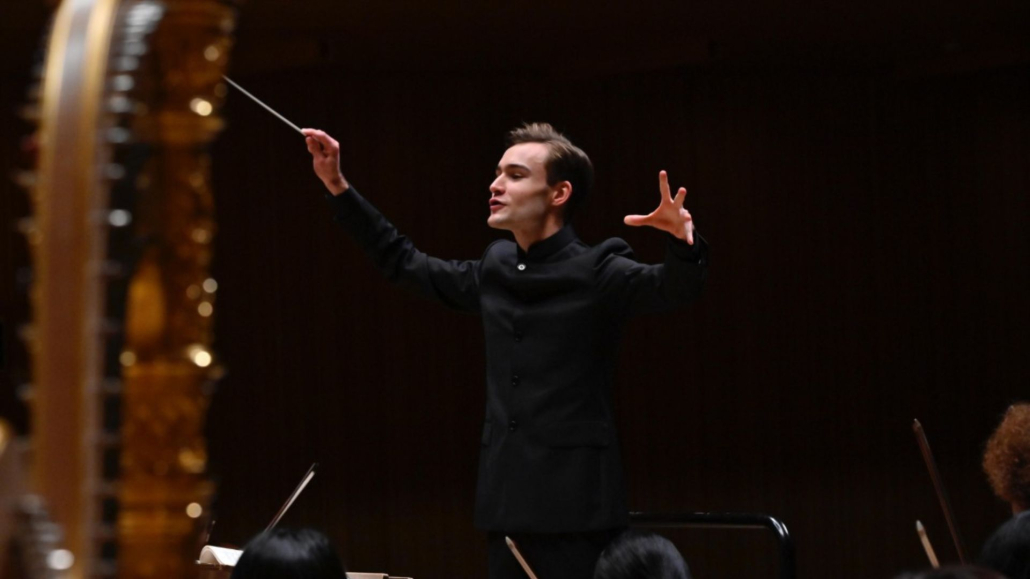
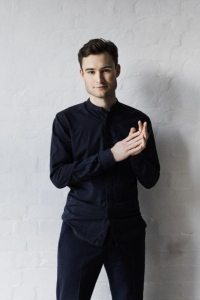 Bertie Baigent, conductor
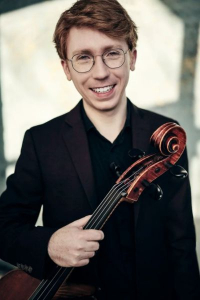 Cameron Crozman, cello