“You love the spotlight, Skylark—the empty stage of field or down, the unwritten page of meadow and heath,” writes British author Robert Macfarlane in his latest opus, The Book of Birds. “You’re a born performer, a levitator with a taste for melodrama: the vertical take-off, the diva’s song flung loud from the thousand-foot cream-puff of a cumulus cloud.
“Sometimes,” he continues, I lie back with the grass as my pillow and try to follow you as you fly without fear right up to the brink of the atmosphere, where you’re lost to my eye but not to my ear, for your song torrents on even when your body is gone: that clear, relentless tumble of notes, those rubbed and rounded pebbles of song, that silver chain of links without a break. We swarm your song with meaning, Skylark: we cannot help it. Beauty, madness, eros, molten metal, a shower of petals.”
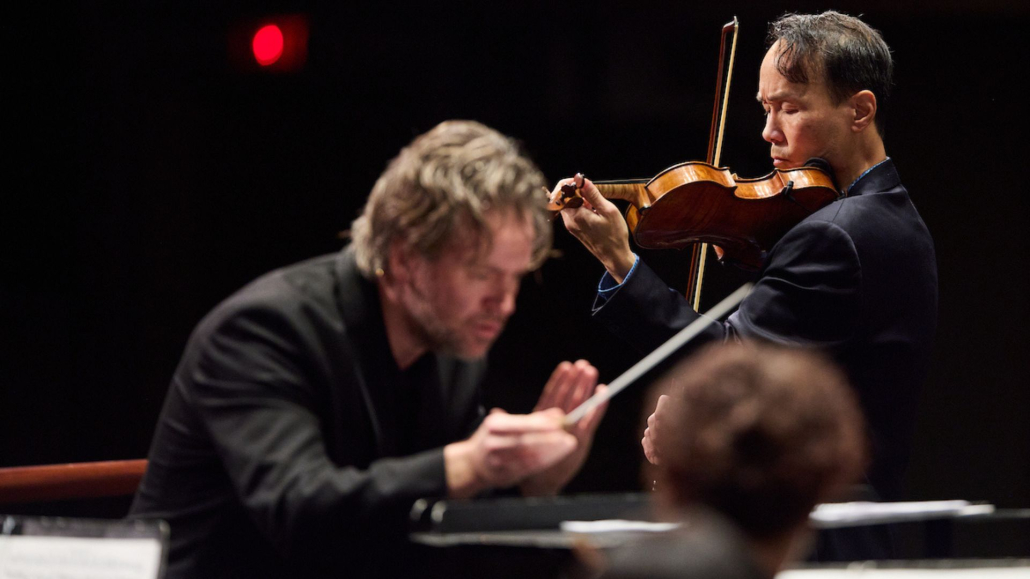
If one applies Macfarlane’s last string of adjectives to Robert Schumann’s Symphony No. 2 in C major they would not be far off the mark. And when it comes to his own The Lark Ascending, Ralph Vaughn Williams would sympathize. Although the English composer’s paean to an iconic British bird, which here will feature Victoria Symphony concertmaster Terence Tam under the baton of Eivind Aadland, does not purport to mimic birdsong, it is an earnest and joyous attempt to convey, in music, the ease and effort of flight. Like the lark’s own song, it is both a love song and a declaration of territory. Here, Vaughan Williams is saying, is the land I hold dear and call my own: the fields and folds around the rustic village of Wotton, Surrey, where he spent much of his childhood.
Edward Elgar, who also appears on this program with his contemporaneous Introduction and Allegro, gave us “Land of Hope and Glory” and “Jerusalem”, works emblematic of a martial England at the pinnacle of empire. Vaughan Williams offers a kinder landscape—but one that’s not empty of challenge, as Tam discovered when he first encountered what is, in effect, a single-movement violin concerto.
“Before I learned this piece, years ago, I was under the impression that it was going to be relatively easy,” he says. “But it actually turned out to be a bigger challenge than I’d thought. Just from the imagery of the piece, and from how beautiful and meditative it sounds, it tends to put me into a state of meditation or deep thought. But there’s a couple of things that stand out about it. The fact that it starts out with a cadenza for the violin is kind of challenging—and it’s not just a short couple of seconds of the violin by itself and then the orchestra comes in. It’s at least 20, 30 seconds of the violin, and it’s clearly the imagery of the bird, the lark, rising and rising and rising. The violin ends up travelling up the range of the instrument to one of the highest notes that the violin can play. It’s not the highest, but it’s in that realm. And it’s also supposed to be very, very soft, so not only do you have to start off by yourself, with nobody to back you up, but you have to then play all the way up the range while still staying very soft.
“There are actually quite a few passages where he writes difficult—or let’s just say not easy—double stops for the violin, and of course double stops are where we play two notes at the same time,” Tam continues. “In general, those are more challenging than playing one note. However, within that realm you can write more difficult double stops, or you can write easier double stops, and some of these that he wrote are actually quite awkward and difficult to play in tune. So those two things, from a technical point of view, stand out for me.”
On the interpretive level, Tam notes that the unofficial subtitle for The Lark Ascending is “A Romance for Violin and Orchestra”. “But it’s not romance in an amorous way,” he specifies, “although it’s clearly very evocative of nature. Obviously, you have the lark, but throughout you can imagine the pastoral nature that this kind of evokes: the rolling hills and the land of England. And then you have, in the middle, some folk themes that are brought out. You can imagine a little village, and a folk dance in the middle… It kind of brings us back down to earth from where the bird has been flying.
“In classical music in general, any time there are birds depicted or birds in the title, you tend to get a lot of trills,” the violinist adds. “That’s kind of the general way that composers would try to depict birds, and it’s no different here. So in that sense, it is very bird-like. It’s just that it’s not a direct quote of what a lark sounds like. And, by the way, I have no idea what a lark actually sounds like!”
Concert-goes should refrain from consulting the Merlin app mid-show, although from across the Atlantic Macfarlane has a helpful hint. “One day find a spare hour and walk out to the old airfield, or the meadow near the hospital where the helicopter lands, or the park on the edge of town, or the burial barrow on the close-cropped down,” he suggests. To anywhere, in fact, that Skylark sings. And there—stop. Watch the skies. Listen. And rise.”
Barrows and downs are in short supply on the West Coast, but birders know that the Saanich peninsula is the only place in Canada—in North America, actually—where skylarks can be heard. A small population was released here in 1903, and a few are clinging on despite urbanization and industrialized, pesticide-heavy agriculture. The fields around Victoria International Airport are a good place to look. But don’t despair if you can’t find your lark: its spirit can be heard in this concert and you, too, will rise with it.
Notes by Alex Varty


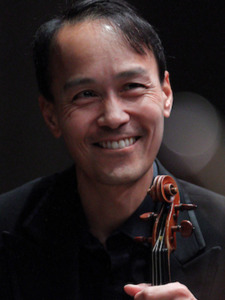 Terence Tam, violin