Loading Events

« All Events

Mozart Violin Concerto No. 1 & Dvořák Czech Suite

August 1 @ 7:30 pm

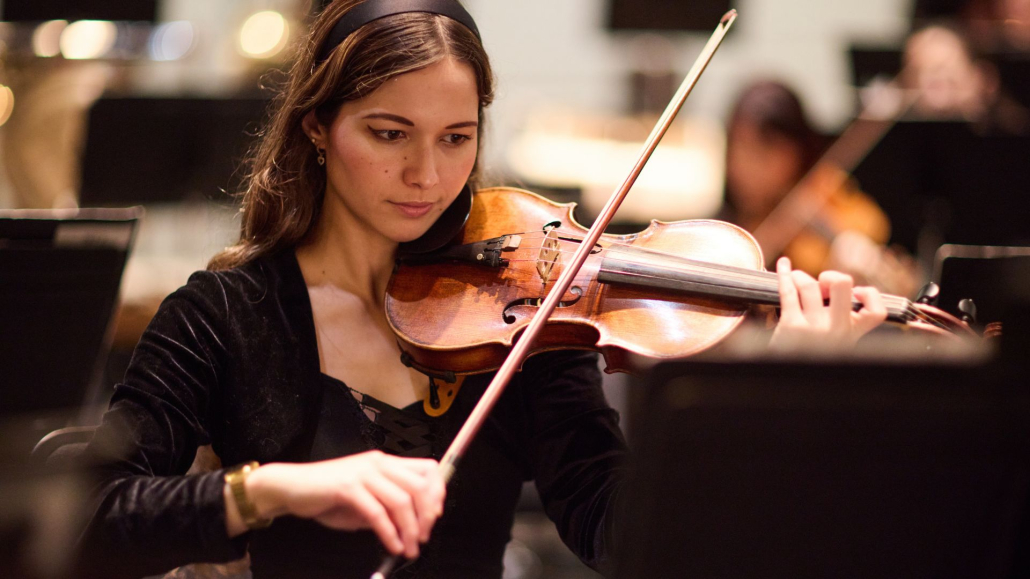
An evening of summer serenity fills Victoria’s Christ Church Cathedral under the baton of Andrei Feher. Weiner’s Serenade for Small Orchestra blends Romantic elegance and Hungarian-inflected melodies, while VS Principal 2nd Violin Kimberly Durflinger takes the spotlight in Mozart’s Violin Concerto No. 1, a youthful work that holds an important place in the violin repertoire. The sunny disposition and pastoral charm of Dvořák’s Czech Suite evoke rolling landscapes and serene nights, bringing the program to a warm close on a summer evening in August.

Please note: Doors open at 7:00 pm.


Andrei Feher, conductor

Canadian-Romanian conductor Andrei Feher has earned a reputation for his musical maturity and integrity, natural authority on the podium, and an imaginative and intelligent approach to programming. He is hailed for his “ability to connect with his players, using their skills as if they were the piano and he the pianist” (The Record).

Feher regularly appears with top Canadian and European orchestras. His noteworthy 2019 debut with the BBC Symphony Orchestra, performing Stravinsky’s Divertimento from The Fairy’s Kiss, was recorded and airs on BBC Radio 3. Subscription appearances include Symphony Nova Scotia, Tokyo Symphony Orchestra, Orquesta sinfónica RTVE Madrid, and Orchestre de Chambre de Lausanne. Additional highlights include appearances as guest conductor with Orchestre Symphonique de Montréal, Orchestre Symphonique de Québec, Les Violons du Roy, Orchestre Philharmonique de Monte-Carlo, Orchestre National d’Ile de France, Orchestre Métropolitain de Montréal and Romanian Radio National Orchestra.

In 2018, at age 26, Feher was appointed Music Director of the Kitchener-Waterloo Symphony, making him one of the youngest to lead a major Canadian orchestra. During his five-year tenure as Music Director, Feher is credited with seeing the Orchestra through pandemic closures with 12 full-orchestra online programs and transforming the symphony’s relationship with French speakers in the region and beyond. Performance highlights under his artistic direction include Carmen, La Traviata, and Mahler’s Second Symphony, with numerous sold-out shows held at the Raffi Armenian Theatre within the Centre In The Square, a concert hall seating over 2,000.

Born in Romania into a family of musicians, Feher began his musical education as a violinist in his hometown Satu-Mare with Nagy Margareta before continuing his studies in Montréal at age 13 when his family immigrated to Canada. An accomplished violinist, he studied at Joseph-François-Perrault and at the Conservatoire de musique de Montréal with Johanne Arel and Raffi Armenian. Feher is based in Montréal with his wife and two young sons.
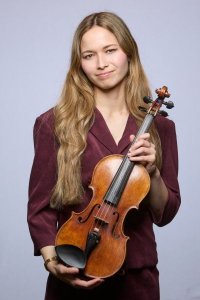
Kimberly Durflinger, violin

Originally from San Diego, California, violinist Kimberly Durflinger is currently Principal 2nd Violin of the Victoria Symphony Orchestra in British Columbia, Canada. She also subs with several major North American orchestras, performs in the rock band Vaerisa, is a session musician with the company Musiversal, and teaches a select number of students privately. She lives in Victoria, BC with her Pembroke Welsh Corgi Maple. In her spare time, she can be found dancing Argentine Tango, baking pies, or catching shiny Pokémon.

An avid orchestral musician, Kimberly began playing professionally with the Thunder Bay Symphony from 2021-2023 as a tenured section violinist. After that, she joined the Victoria Symphony in 2023 as a tenured section violinist, and has continued to perform there. Additionally, she has subbed with many major North American orchestras such as the San Diego Symphony, National Arts Center Orchestra of Canada, Canadian Opera Company Orchestra, I Musici Orchestre Chambre de Montréal, and the Kitchener-Waterloo Symphony Orchestra.

Kimberly has a versatile skill set, due to her passion towards genres of music outside the realm of classical music. In 2025, she joined the roster of musicians at Musiversal – a company that connects session musicians with clients all around the world. In one year alone, she has already been booked and recorded for over 700 sessions. Additionally, she is a member of the Toronto-based rock band Vaerisa, which was formed in 2018. Vaerisa has toured the east coast of Canada, and has taken part in festivals and events such as Toronto’s Indie Week, and been featured in Stencil Magazine UK.

In addition to Vaerisa, Kimberly enjoys taking on projects from a variety of sources, including premieres of contemporary composers, performing live tango music to Argentine Tango dancers at a Tango festival, playing punk-rock music at the House of Blues in San Diego, and recording the theme song to the video game Renaine on the Nintendo Switch.

Classically trained, she graduated with a Master’s Degree in Violin Performance from the Schulich School of Music of McGill University in 2018 and a Bachelor’s Degree in Violin Performance from the Eastman School of Music in 2016. She has been coached and guided by wonderful musicians and people such as Andrew Wan, Jonathan Crow, Leah Roseman, Alexander Read, Lynn Blakeslee, Jing Yan Bowcott, Alexandra ‘Olga’ Keegan, and Morgan Wheeler.

Leó Weiner (1885—1960)
Serenade, Op. 3

Wolfgang Amadeus Mozart (1756—1791)
Violin Concerto No. 1

Antonín Dvořák (1841-1904)
Czech Suite

From the Hungarian-inflected lyricism of Leó Weiner to Mozart’s youthful brilliance and the folk-rooted warmth of Dvořák, this evening’s program reveals how composers draw from the worlds around them — transforming dance, song, and memory into orchestral expression.

Leó Weiner’s Serenade for Small Orchestra opens the program with music that many listeners may be encountering for the first time. Though not widely known outside Hungary, Weiner occupies an important place in Central European music, blending late-Romantic orchestral writing with the melodic and rhythmic qualities of Hungarian folk traditions.

For conductor Andrei Feher, the work carries a personal connection. Growing up in Romania, he was surrounded by the musical language that shaped Weiner’s world. He describes the piece as full of both “dancing and nostalgic music,” qualities that define much of the folk-inspired repertoire of the region. That balance is especially vivid in the third movement, where a clarinet solo creates what Feher calls a meditative and deeply nostalgic moment — a brief stillness at the heart of the work.

Mozart’s Violin Concerto No. 1, composed in 1773 when he was just nineteen, reveals a composer already astonishingly comfortable with form and invention. Though often overshadowed by his later violin concertos, this early work contains all the hallmarks of Mozart’s genius: elegance, balance, wit, and melodic ease.

Feher points to the concerto’s creativity within conventional structures, noting that even at this young age Mozart was already “a master of the conventional form,” finding ways to play with expectations while remaining effortlessly clear.

This performance also marks an important moment for soloist Kimberly Durflinger, Principal Second Violin of the Victoria Symphony, making her first concerto appearance with the orchestra. Having recently stepped into a leadership role, Durflinger brings a deep understanding of the ensemble from within. She describes the orchestra as “an orchestra family,” shaped as much by personal connection as by musical collaboration.

For Durflinger, Mozart’s First Concerto feels “hopeful” and “sparkling,” comparing its energy to “a cascade of blooming flowers — like taking one look at the Butchart Gardens.” It’s an image that captures the freshness and ease of the music perfectly. She has also written her own cadenzas for this performance, embracing the spirit of invention and spontaneity that lies at the heart of Mozart’s music.

The slow second movement holds special meaning for her. Recalling her mother’s habit of naming “the slow piece” as her favorite part of a concert, Durflinger reflects on the way these quieter moments allow listeners to settle fully into the experience — to let the noise of daily life fall away and simply listen.

Antonín Dvořák’s Czech Suite, written in 1879, closes the evening in music deeply rooted in the folk traditions of his homeland. Full of pastoral warmth, lyrical melodies, and dance rhythms, the suite reflects Dvořák’s lifelong ability to transform vernacular music into richly crafted orchestral writing.

Feher describes the emotional world of Dvořák’s music as one of “pastoral nostalgia,” a quality that gives even its brightest passages a reflective depth. Throughout the suite, listeners will hear the interplay between folk dance and symphonic craft, culminating in the final Furiant — a lively Czech dance marked by shifting accents, rhythmic energy, and exhilarating momentum.

Together, these works celebrate music as a living expression of tradition, place, and memory — an evening shaped by distinct national voices, but united by their ability to speak directly to the heart.

Details

Venue

Concert Programme

  • Weiner
    Serenade for Small Orchestra
  • Mozart
    Violin Concerto No. 1 in B♭ major
  • Dvořák
    Czech Suite

Victoria Symphony respectfully acknowledges and offers gratitude to the lək̓ʷəŋən people, known today as the Songhees and Xwsepsum Nations, whose unceded lands we live, work, and perform on. We honour their stewardship, care, and leadership — past, present, and future.