This evening’s program brings together three composers separated by more than two centuries, each working within inherited traditions while finding new ways to stretch and reshape them. From Kelly-Marie Murphy’s contemporary response to Beethoven’s heroic legacy, to Beethoven’s own playful reimagining of Classical form, to Poulenc’s colorful and witty twentieth-century voice, these works remind us that musical tradition is never static. It is always being rethought.
Canadian composer Kelly-Marie Murphy’s On Rethinking Heroism in the 21st Century, written in 2020, begins with Beethoven’s Eroica Symphony — one of the great monuments of Western music. Beethoven’s Third Symphony transformed the symphony into a larger and more ambitious form, forever changing what orchestral music could express. But Murphy’s piece is less concerned with celebrating that legacy than with questioning it.
Rather than presenting Beethoven’s ideas directly, Murphy allows fragments of the Eroica to surface and disappear throughout the piece, weaving them into her own distinct musical language. Conductor Andrei Feher, who has performed the work several times, notes that “Beethoven’s music comes and goes” before the piece arrives at a triumphant conclusion. In doing so, Murphy creates a conversation across time — one that asks what heroism sounds like now, in an era where the idea itself feels more complicated than ever.
Beethoven’s Symphony No. 8, completed in 1812, offers a striking contrast. Coming directly after the enormous energy and scale of the Seventh Symphony, the Eighth is shorter, lighter, and more compact. Yet its modest dimensions conceal some of Beethoven’s most inventive and surprising writing.
Feher describes the symphony as a moment where Beethoven “shows how funny he can be.” Rather than meeting expectations for another large-scale heroic statement, Beethoven turns toward wit, elegance, and playful experimentation. The famous second movement, with its ticking rhythmic pattern, is often heard as a joke about the newly invented metronome. Elsewhere, Beethoven bends familiar forms in unexpected ways, stretching and teasing musical conventions without ever breaking them.
There is a remarkable freshness to this symphony — music that feels at once youthful and completely self-assured. Beethoven no longer needs to prove anything. Instead, he seems to delight in surprising us.
Francis Poulenc’s Sinfonietta, written in 1947 for the BBC, closes the evening with music full of sparkle, charm, and unmistakable personality. Though modestly scaled, it contains many of the qualities that define Poulenc’s music: lyricism, wit, and sudden harmonic turns that can shift the mood in an instant.
Feher describes the piece as “quirky,” a fitting word for music so full of unexpected character. Poulenc balances playful energy with sensuality, allowing bright textures and elegant melodies to coexist with moments of deeper warmth. His harmonic language, distinctly French in its color and flexibility, gives the work its particular glow.
Like Beethoven’s Eighth, the Sinfonietta finds freedom within familiar forms. Its gestures are often light on the surface, but beneath them lies a restless imagination, constantly reshaping the music’s direction.
Taken together, these works form a compelling arc: Murphy reconsiders Beethoven’s heroic voice from the perspective of the present; Beethoven reimagines the Classical symphony with humor and invention; and Poulenc brings that same spirit of reinvention into the twentieth century.
Across all three, one thing remains constant: the enduring ability of composers to inherit old forms and make them speak in new ways.


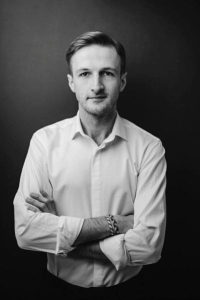 Andrei Feher, conductor