In the great Norwegian writer of crime fiction Jo Nesbø’s Knife, a character is described as carefully placing his feet, “like someone who automatically looks for landmines”. That’s probably the best way to enter into a discussion of nationalism in music, a metaphorical minefield in which even the best intentions can easily explode, and where pitfalls abound. But avoiding the topic altogether is not possible when considering a program that contains long, serious, and enduring works from the inventor of Finland’s vital symphonic tradition, Jean Sibelius, and the sonic herald of Czech republicanism, Antonín Dvořák. That’s especially true when the third composer on the program, Heino Eller, played a comparable if less celebrated role in his native Estonia.
At least all three of these artists were operating from a place of love and concern for their homeland, rather than subscribing to the arrogant chauvinism so common today.
Opening with Eller’s symphonic poem Koit could not be more appropriate. “Sunrise” seems to be a preoccupation with Nordic and Baltic composers; see Raminta Šerkšnytė’s Midsummer Song, which begins with a dawn chorus and insectile thrumming and will be performed later in the Victoria Symphony’s 2026/27 Season. Is it that the short winter days mean that residents of northern climes see more of them than those who live where waking in darkness is not the norm? The nationalist component here is that Koit, which was written between 1916 and 1918, is exactly contemporaneous with Estonia’s longed-for emergence from Russian domination—an independence that that was lost after the Second World War, regained in 1991, and that remains fragile to this day.
The use of folk motifs is a fixture in Classical and Romantic repertoire, but few composers have been as thoroughly embedded in their national mythology as Sibelius, perhaps because the Finnish language—and the musical tropes that have risen from its cadences—is so remote from those of its Slavic, German, and Scandinavian neighbours. This has no doubt come under careful scrutiny in academia, but what we can say here and now is that not only did Sibelius’s music carry echoes of Finland’s Indigenous folk harp, the kantele, it very often illustrates narrative themes derived from the country’s founding myth, the sprawling epic known as the Kalevala.
Equivalent to the Norse sagas, the Hindu Bhagavad Gita, or the Odyssey and Iliad of Homer, this linked collection of 50 folk tales finds explicit expression in Sibelius’s Kullervo, Lemminkäinen Suite, Pohjola’s Daughter, Luonnotar, and Tapiola. It’s not at all an exaggeration to say that without the composer’s close scrutiny of the Kalevala, these works wouldn’t—or couldn’t—exist. The mythic component of the Violin Concerto in D minor, which here will be played by the Canadian virtuoso Blake Pouliot, is less immediately scrutable. Written for the German violinist Willy Burmester but somewhat controversially premiered by the considerably less accomplished Victor Nováček, it was clearly meant to show off the soloist’s skill, as opposed to advancing any specific social or political message. The only passage that seems explicitly northern, let alone Finnish, is the final “Allegro, ma non tanto” movement, which the British musicologist Donald Tovey once memorably described as “a polonaise for polar bears”. But ascribing any nationalistic intent to this is a stretch. Polar bears do not recognize boundaries.
It may be worth noting, too, that the Violin Concerto in D minor is the only concerto that Sibelius wrote. Did he not like the form, or did its emphasis on individual achievement not fit with his conception of Finland’s collective identity?
Dvořák’s Symphony No. 9 in E minor, better known as “From the New World”, is another anomaly, this time because it is one of the few works from the composer that purports to do something other than exalt his Central European heritage. In this case, Dvořák wanted to honour the United States, where he’d been hired as director of the National Conservatory of Music of America in 1892. In this he succeeded, with one notable achievement being his recognition of the African-American spiritual as one of the ‘New World’ Symphony’s greatest artistic achievements. The first movement lifts the melody of the Black hymn “Swing Low, Sweet Chariot” wholesale, and to his credit Dvořák did not hesitate to acknowledge his inspiration—although it’s taken more recent scholarship to reveal the extent to which his African-American friend, aide, and student Harry Burleigh served as amanuensis.
“Dvořák used to get tired during the day and I would sing to him after supper,” Burleigh once recalled. “I gave him what I knew of Negro songs—no one called them spirituals then—and he wrote some of my tunes (my people’s music) into the ‘New World’ Symphony.” The composer, in turn, apparently commented that the spiritual “Go Down Moses” was “as great as a Beethoven theme”. One might wish for a less Eurocentric viewpoint, but for 1893 Dvořák’s stance was nearly unprecedented—and the subsequent evolution of jazz and other African-American art forms has shown him to be correct.
Yet even in self-imposed exile, Dvořák never lost touch with his Czech and more explicitly Bohemian roots. The ‘New World’ Symphony’s second movement, “Largo”, quotes a Czech folk melody; ironically, it was later appropriated by the American composer William Arms Fisher and used as the tune for the popular gospel song “Going Home”. In letters sent back to his own home, the composer alternately celebrated American fizz and vigour and admitted that he missed his native language, good Pilsner, and the streets of Prague.
Dvořák wrote other works that addressed his American experiences; to follow Symphony No. 9 we’d highly recommend seeking out his comparatively overlooked String Quartet No. 12 in F major, in which his inspirations include the distinctively East Coast call of a scarlet tanager. Far beyond his gifts as a kind of musical travel writer, however, Dvořák’s greatest contribution to world culture is arguably the part he played in creating a distinctively Czech national identity, which ultimately resulted in Czechoslovakia breaking away from the Austro-Hungarian empire in 1918 and shedding its Soviet shackles in 1989. The long-lived Sibelius, in turn, survived alcoholism and depression to see Finland escape Russian clutches in 1919, resist both Soviet and Nazi imperialism during the Second World War, and become one of the world’s leading forces in design, aviation, and musical pedagogy, both folk-oriented and classical. We owe them, and positive nationalists like them, a lot.
Notes by Alex Varty


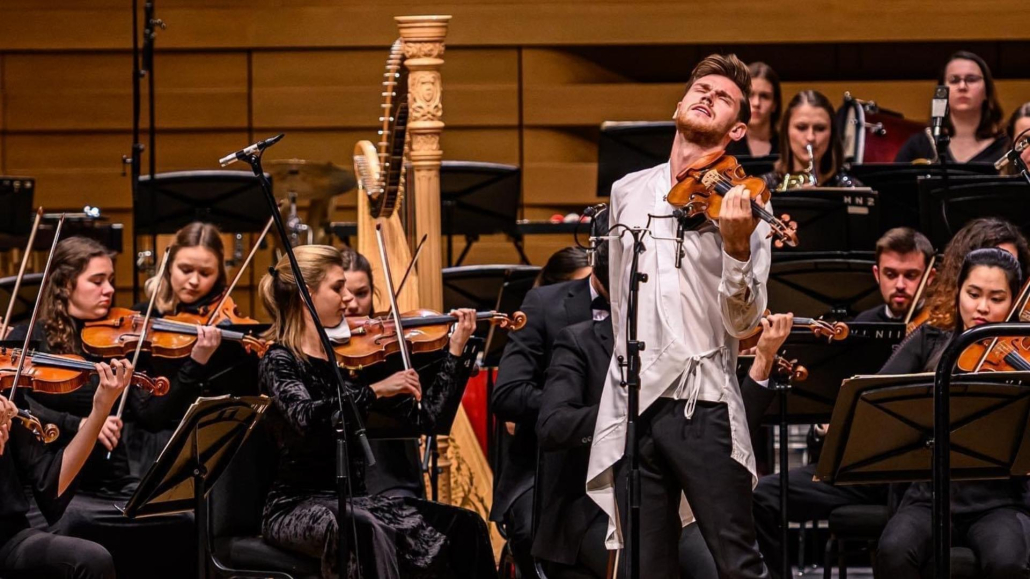
 Christian Kluxen, conductor
 Blake Pouliot, violin